
Environmental Monitoring Should Support Better Operations
Inspired by Ghana's digital agenda, Liberian businesses can reframe environmental monitoring as data-driven operational management, using simple metrics to improve efficiency, cut costs, and build credibility with partners.
Editorial analysis. This piece reflects Executive Tea Chronicle's interpretation and editorial mission, not an official government position.
Analysis. Drafted from cited World Bank sources for editor review; Liberia proposals are the magazine's analysis, not source findings.
Source scope: the cited sources describe historical project designs and financing announcements (2021–2024), not verified current implementation outcomes. No new Liberia-specific factual evidence was checked for this draft; Liberia scenarios are hypothetical.
For any business, from a small workshop to a large processing plant, information is the foundation of control. Managers typically track metrics like labor hours, inventory, and sales. However, information about operational resources like water, energy, and raw materials—and the waste generated from their use—can sometimes be overlooked. Viewing this data as a secondary concern represents a missed opportunity. Effective business management includes managing a company's resource footprint, not as an abstract environmental exercise, but as a core component of operational efficiency and financial health.
A disciplined approach to collecting and using operational data can help transform a business. It provides a clear, factual basis for identifying waste, reducing costs, and improving processes. Rather than being solely a compliance exercise, this kind of internal monitoring is a tool for self-improvement. It allows a company to understand its own operational flows: what it consumes, what it produces, and what it discards. Such a shift in perspective could be valuable for enterprises in Liberia seeking to become more competitive.
The principle of harnessing data for economic progress has been a focus of development programs in West Africa. In Ghana, for instance, a 2022 financing announcement for a national project signaled a strategy to use information technology to drive growth and efficiency.
What the comparison shows
Ghana’s planned digital development provides a useful context for how a national strategy can prioritize data-driven systems. According to a World Bank press release from April 28, 2022, the Bank approved $200 million for a Ghana Digital Acceleration Project. The project’s stated goals were to increase citizen access to broadband, enhance the efficiency of selected digital public services, and strengthen the digital innovation ecosystem.
As announced in 2022, the World Bank described this project as a way to advance a “whole-of-government digital transformation agenda” and support post-COVID-19 recovery. Building on a previous e-Transform Ghana project, the funding was intended to support regulatory changes promoting digital inclusion and streamlining government service delivery. The project was also expected to increase access to mobile internet and broadband services for six million people, with a focus on encouraging private sector investment in underserved rural areas.
For this analysis, a key component was the project’s aim to facilitate what the World Bank termed “data-driven digital agriculture.” This component illustrates an intent to apply digital tools not just to urban services or tech startups, but to a core productive sector. The underlying idea is that better data can enable better decisions, whether for a smallholder farmer or a government agency. It is this principle—using systematic data to improve real-world operations—that is relevant for industrial operations in Liberia.
Analysis: applying the lesson in Liberia
The relevance of the Ghana project's design is not in copying a specific program, but in adopting the underlying mindset. Businesses in Liberia could apply this data-driven approach on an individual basis, focusing on practical, operational monitoring that directly supports business goals.
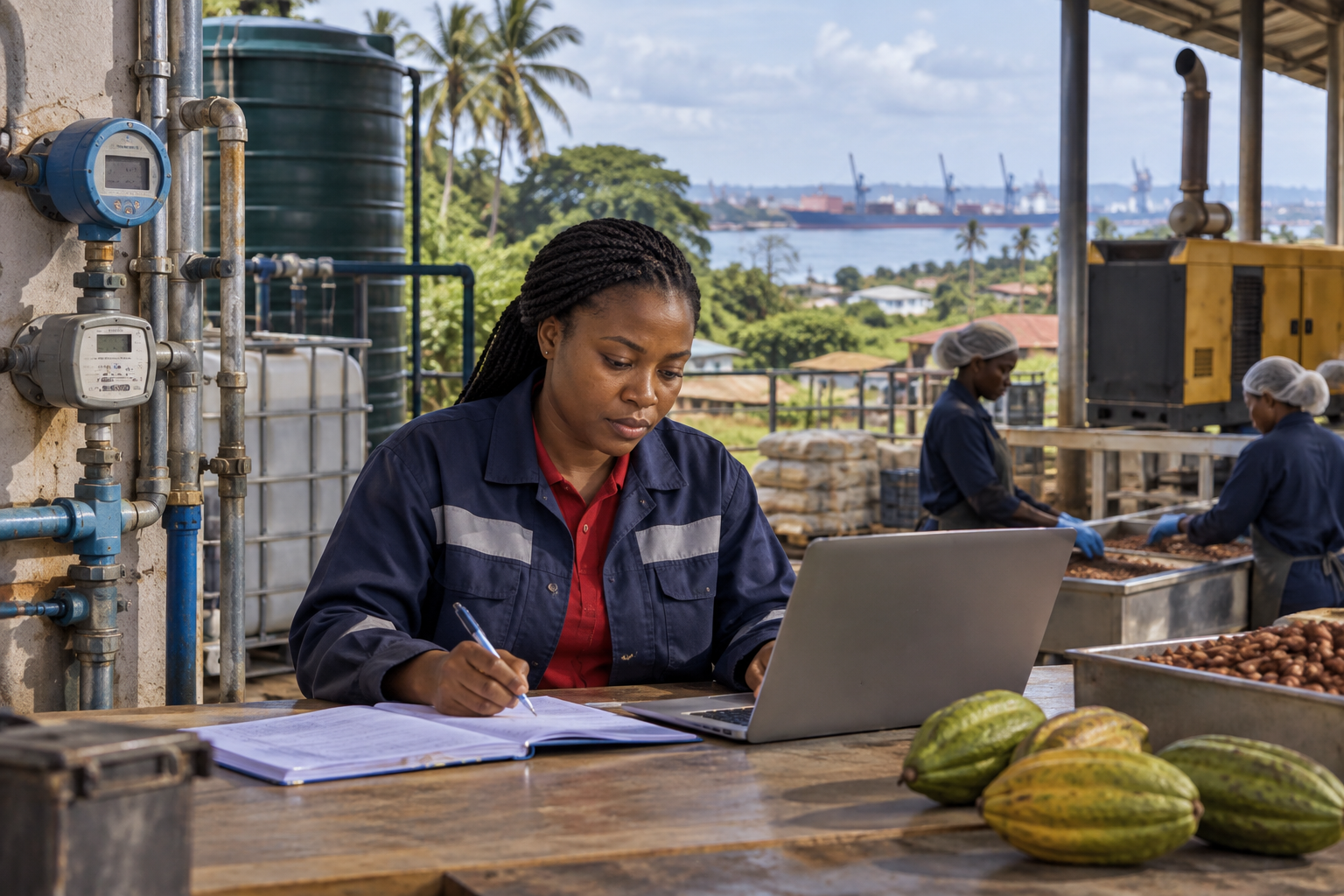
Consider a hypothetical food processing facility. The management could decide to start by tracking three simple metrics: monthly electricity consumption and generator fuel usage; total cubic meters of water used; and the total weight of solid waste sent for disposal. These are not complex environmental studies, but basic indicators of operational efficiency. A first step could be installing meters and establishing a simple logbook or spreadsheet. The manager’s role would be to ensure data is recorded consistently and to explain to staff how it connects to business goals, such as reducing fuel costs, spotting water leaks early, or finding ways to sell or reuse waste materials.
For instance, if the data shows that water consumption per ton of processed goods suddenly jumps by an illustrative 20%, it would trigger an investigation into potential causes like a leaking pipe, a malfunctioning valve, or an inefficient washing process. Answering these questions could lead to direct cost savings. Similarly, a hypothetical wholesaler might track fuel consumption across its delivery fleet. By analyzing data on mileage, routes, and vehicle maintenance, the owner could optimize delivery schedules and reduce a significant variable cost. This is environmental management in its most practical form: resource management.
Tradeoffs and implementation risks
This approach has potential challenges. A primary risk is implementing monitoring as a formulaic exercise. If data is collected but not analyzed or acted upon, the effort is wasted and drains staff time. The purpose must be clear from the outset: to gain insights that lead to improvement. Another risk is a mismatch between the complexity of a monitoring system and a business's capacity. For example, a small workshop may not need the same sensor network as a large processing plant. The principle is proportionality: starting with simple, high-impact metrics that can be tracked reliably with existing resources, and building from there.
There are also potential costs for equipment and expertise. While a basic logbook is inexpensive, accurate meters for water or electricity have an upfront cost. For more complex issues, such as analyzing wastewater content, a business might need to hire a qualified external specialist. These costs, however, should be weighed against the potential savings from reduced waste and greater efficiency. The investment in better information can often pay for itself.
What global competence looks like here
In an interconnected economy, having a firm grasp of operational data can be a mark of competence. International buyers, lenders, and partners may ask questions about sustainability and operational standards. A company in Liberia that can provide clear, verifiable data on its energy use, water management, and waste reduction could be viewed as more credible than one that cannot. It can demonstrate professionalism and a commitment to modern management practices.
The goal is not necessarily to produce formal sustainability reports, but to possess the operational intelligence to answer specific questions with factual data. When seeking financing for an expansion, showing a trend of declining energy use per unit of production can make a stronger case. When negotiating an export contract, providing records of compliance with waste disposal protocols can be a differentiator. This internal discipline can build external credibility and open doors to new opportunities.
Bottom line
Environmental monitoring can be viewed not as an external regulatory burden, but as an internal management tool. Following the principle of using data-driven systems, as seen in the design of the Ghana project, enterprises in Liberia can take practical steps to track resource use and waste. A potential benefit is enhanced operational control and reduced costs. The long-term reward could be a more resilient, efficient, and credible business prepared to compete in a wider market.
Sources
- World Bank Provides $200 Million to Accelerate Ghana’s Digital Transformation Agenda for Better Jobs — World Bank, published 2022-04-28
Related reading

Agricultural Technology Should Begin With a Farmer Problem
For agri-tech to succeed in Liberia, it must move beyond hype and be co-designed with farmers to solve a specific, identified problem, adapting technology to local conditions rather than imposing generic solutions.
Supply Chain Records Can Make Trade More Dependable
Applying the principles of Kenya's national digital strategy to Liberian agriculture could create a system of shared records, reducing disputes and making trade more dependable for farmers and buyers alike.
Food Processing Needs Consistent Quality Records
To scale up, Liberian food processors must adopt disciplined record-keeping systems that link technology and workforce training, building the verifiable consistency that commercial buyers demand.