
Food Processing Needs Consistent Quality Records
To scale up, Liberian food processors must adopt disciplined record-keeping systems that link technology and workforce training, building the verifiable consistency that commercial buyers demand.
Editorial analysis. This piece reflects Executive Tea Chronicle's interpretation and editorial mission, not an official government position.
Analysis. Drafted from cited World Bank sources for editor review; Liberia proposals are the magazine's analysis, not source findings.
Source scope: the cited sources describe historical project designs and financing announcements (2021–2024), not verified current implementation outcomes. No new Liberia-specific factual evidence was checked for this draft; Liberia scenarios are hypothetical.
For many small-scale food processors, the journey from a local product to a brand with commercial reach is fraught with obstacles. A common challenge is product consistency. A batch of a food product that is well-received one week can be subtly different the next, which can undermine the trust of larger buyers like supermarkets, hotels, or exporters. The key to overcoming this challenge often lies not just in a better recipe, but in better discipline—a verifiable, repeatable process documented from start to finish. This is not merely about paperwork; it is the foundation of industrial quality control.
Building this capacity requires a fusion of appropriate technology and targeted workforce skills. While this may sound resource-intensive, the focus can be on practical, accessible tools that create a culture of documentation and precision. Insights from development projects show that linking enterprise technology adoption with skills training is a recognized strategy for strengthening small and medium-sized enterprises (MSMEs). By adapting this principle, it is possible to chart a pragmatic course for agri-processors in a context like Liberia's to build the operational credibility they need to grow.
What the comparison shows
Some development projects provide frameworks for connecting these elements. In Burkina Faso, for example, a project design approved by the World Bank in 2023 aims to strengthen MSMEs by integrating technology access with labor force development. According to a project appraisal document, the initiative’s objective is to increase MSME access to finance, technology, and a better-trained workforce.
The project’s structure is notable for its deliberate synergy. One component is designed specifically to strengthen MSME capabilities and support technology adoption. Another component, in parallel, is designed to develop a productive and entrepreneurial labor force. The plan states an aim to help build the set of skills needed for the success of technology-focused activities supported elsewhere in the project. The approach includes improving formal technical and vocational education and training (TVET) as well as increasing non-formal training opportunities for low-skilled youth. This strategic pairing acknowledges a general principle: technology is only effective when people are trained not just to use it, but to understand its purpose within a production system.
Analysis: applying the lesson in Liberia
For Liberia, the lesson is not to copy a specific program, but to embrace its core logic. “Technology adoption” for a small food processor does not need to mean complex automation. It can begin with a simple digital ledger or a spreadsheet application on a common device to create consistent quality records. The power of this approach is its ability to encourage discipline and create an auditable history for every batch produced.
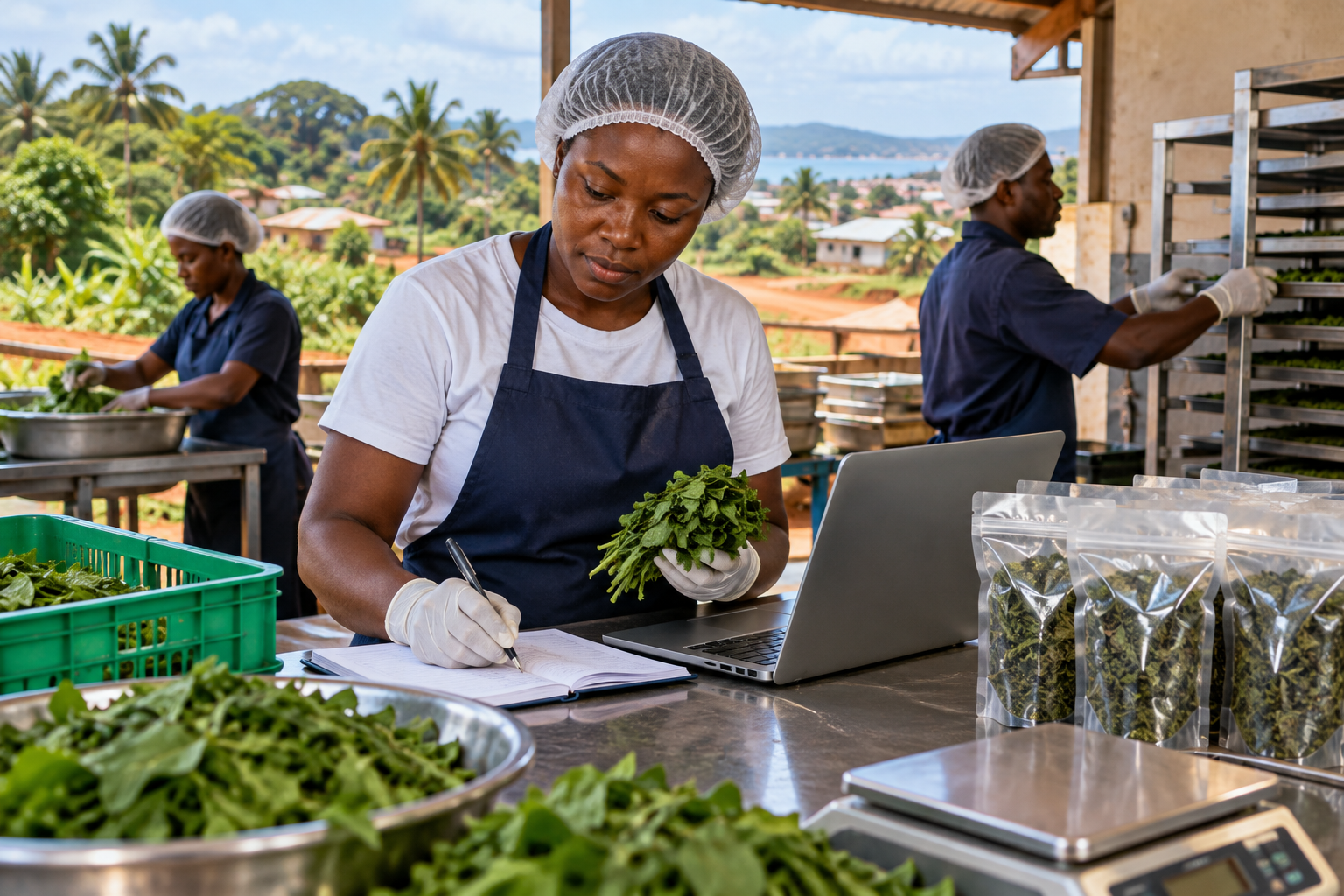
Consider a hypothetical processor of packaged dried potato greens in Bong County. Implementing a basic digital record-keeping system would mean that for every batch, an employee would log key data points. This could include:
- Raw Material Intake: Supplier name, date of purchase, and visual inspection notes for each bag of greens.
- Processing Steps: Timestamps for washing, blanching, drying, and packaging, along with the name of the employee responsible for each stage.
- Equipment Checks: Daily logs confirming that drying racks were cleaned, packaging sealers are at the correct temperature, and scales are calibrated.
- Finished Product: A unique batch number for the final packaged goods, linking them back to all preceding records.
The workforce development component is just as crucial. Employees must be trained on why this data matters. They need to understand that recording the supplier allows for traceability if a quality issue arises. They must see that logging cleaning schedules is essential for food safety and preventing spoilage, which directly impacts the business’s reputation and bottom line. This elevates the task from a chore to a professional responsibility.
Tradeoffs and implementation risks
Of course, implementation is not without its risks. A common one is creating a system of “paperwork for paperwork’s sake,” where records are filled out retrospectively without reflecting actual practice. This can only be mitigated by management that actively uses the data to make decisions—for example, by reviewing equipment logs during maintenance planning or checking batch records when a customer gives feedback. The goal is an active, living system, not a passive archive.
Another risk is choosing technology that is too complex or expensive for the context. The system must be robust and user-friendly. Furthermore, record-keeping alone does not create a safe, high-quality product. It only documents the process being followed. Processors will still need access to qualified technical guidance—from food scientists or experienced technicians—to ensure their production methods for things like acidity, moisture content, and preservation meet established safety and quality standards. A support program could therefore help firms access this professional advice to design their processes, which the record-keeping system would then help them execute consistently.
What global competence looks like here
Meeting the standards of a broader market is the definition of global competence in this context, even if that market is just a major supermarket in Monrovia. A commercial buyer’s primary concern is risk—the risk of inconsistent quality, unsafe products, and damage to their own brand. A processor who can produce a folder of clear, consistent batch records for the past three months is having a completely different conversation than one who simply says, “trust me.”
Documentation provides objective proof of operational control. It demonstrates that the business is managed professionally and is capable of reliably fulfilling a contract. This documented history becomes a powerful asset, creating a stronger basis to negotiate with wholesalers, secure a loan for expansion, or pursue a certification. The immediate goal is not necessarily an international standard, but the internal capacity for consistent operations with traceable records.
Bottom line
For Liberia’s food processing sector to increase its commercial scale, a key step is the transition from artisanal variability toward commercial reliability. Adopting systematic quality records is a foundational part of this process. By linking simple, appropriate technology with practical workforce training—a principle found in development strategies like the one planned for Burkina Faso—processors can build the operational discipline required for growth. The goal is not to add bureaucracy, but to create a verifiable system of quality that can unlock access to larger, more lucrative markets and build more resilient businesses.
Sources
- Burkina Faso - Entrepreneurship, Skills, and Technology Project (Project Appraisal Document, P177005) — World Bank, published 2023-04-17
Related reading

Agricultural Technology Should Begin With a Farmer Problem
For agri-tech to succeed in Liberia, it must move beyond hype and be co-designed with farmers to solve a specific, identified problem, adapting technology to local conditions rather than imposing generic solutions.
Supply Chain Records Can Make Trade More Dependable
Applying the principles of Kenya's national digital strategy to Liberian agriculture could create a system of shared records, reducing disputes and making trade more dependable for farmers and buyers alike.

Market Information Needs a Trustworthy Collection Method
While digital connectivity offers a path to empower Liberian farmers with market prices, the true value of such a service will depend entirely on a disciplined and transparent method for collecting that data.