
Young Professionals Need Evidence of Competence
To bridge the gap between academic credentials and employer needs, Liberia should adopt portfolio-based assessments where young professionals produce vetted, real-world work as tangible evidence of their competence.

Editorial analysis. This piece reflects Executive Tea Chronicle's interpretation and editorial mission, not an official government position.
Analysis. Drafted from cited World Bank sources for editor review; Liberia proposals are the magazine's analysis, not source findings.
Source scope: the cited sources describe historical project designs and financing announcements (2021–2024), not verified current implementation outcomes. No new Liberia-specific factual evidence was checked for this draft; Liberia scenarios are hypothetical.
In many professional landscapes, a gap can exist between holding a university degree and securing a job offer. Graduates with academic transcripts may still face challenges in persuading employers that they possess the practical skills needed for a given role. This type of information asymmetry can create a risk that factors other than demonstrable competence influence hiring decisions, potentially disadvantaging both skilled applicants and employers. The challenge, in such cases, may not be a lack of knowledge, but a lack of credible evidence of applied skill.
To foster a more meritocratic and dynamic economy, one approach is to develop stronger signals of professional ability. This would mean moving beyond traditional academic metrics to cultivate tangible proof of what a young professional can execute. Some African nations are integrating this thinking into their national development strategies, providing potential models for consideration. By focusing on how skills are developed and, more importantly, how they are demonstrated, it may be possible to build a more reliable bridge between education and employment.
What the comparison shows
An initiative in East Africa announced in 2023 provides a useful point of reference. According to a World Bank press release from 5 April 2023, the institution’s board approved $390 million in financing for the first phase of the Kenya Digital Economy Acceleration Project. The program is designed not only to expand access to high-speed internet and improve the delivery of education and selected government services, but also explicitly to build skills for the regional digital economy. This project design, as described by the World Bank, does not treat infrastructure and human capital as separate issues; it intertwines them.
The project, which will run in phases, aims to develop a competitive labor force capable of capitalizing on new digital infrastructure. One stated objective is to boost digital skills to support the uptake of digital services. The project design also aims to mobilize an estimated $100 million in private capital for broadband development. While the program’s goals are expansive, including increasing connectivity for over 70% of Kenya’s population in rural and underserved areas, the inclusion of skills development as a core pillar is a notable feature of its approach. It suggests a recognition that infrastructure is of limited use without people trained to leverage it for commerce, innovation, and productivity.
Analysis: applying the lesson in Liberia
An instructive lesson could be drawn from this emphasis on applied skills. One potential application could be to formalize a system where higher education and technical training programs require students to produce a portfolio of professionally relevant work. This would go beyond a simple internship report, involving the creation of a collection of supervised, evaluated projects that demonstrate a graduate’s ability to execute tasks to a professional standard.
Imagine a framework integrated into final-year studies. A hypothetical accounting student might be assigned to a small business to help reconcile its quarterly financial records, under the joint supervision of a professor and the business owner. The final output for their portfolio would not be just the balanced sheet, but a short report detailing the process, the accounting standards applied, and how they identified and corrected discrepancies. Similarly, a hypothetical public administration student could be tasked with creating a workflow diagram and a citizen feedback form for a local municipal service. The deliverable would be a practical tool, accompanied by an explanation of the choices made in its design.
Tradeoffs and implementation risks
This approach is not without challenges. A primary risk is the administrative burden. Such a system would require significant coordination between academic institutions and a wide range of host partners in the private, public, and non-profit sectors. There is also the critical issue of confidentiality. Clear protocols would need to be established to ensure that students can showcase their work without compromising sensitive business or personal data. A student’s portfolio entry might feature a summary of a task and a description of the outcome, with confidential details redacted or described in general terms.
Furthermore, it would be important to guard against the system becoming a simple box-ticking exercise. The value of the portfolio would be directly tied to the rigor of the supervision and evaluation. If mentors were to simply sign off on mediocre work, the system would fail to build the trust it is designed to create. Success would hinge on a shared commitment to quality from educators and industry partners alike.
What global competence looks like here
A well-curated professional portfolio can be an embodiment of professional competence. It demonstrates that an individual can produce work that is understandable, verifiable, and useful to others. When a potential employer reviews a project, they are not just seeing a technical skill; they are seeing evidence of structured thinking, clear communication, and professional discipline. They can see how a candidate defines a problem, executes a solution, and explains their work.
For such a system to be effective, each portfolio piece would need to state the student’s individual contribution clearly, especially in group projects. Honesty and precision would be paramount. This practice trains young professionals to represent their own work accurately—a foundational skill for any career. It prepares them to function in modern team environments where clarity and accountability are essential.
Bottom line
To support Liberia’s economic development, a workforce that can prove its value in a competitive marketplace is a critical asset. While degrees and diplomas are foundational, they may not by themselves convince employers to invest in new talent. A portfolio of vetted, real-world work could provide credible evidence of ability. It allows a young professional to shift the conversation from “I have a degree in finance” to “Let me show you how I analyzed a company’s cash flow and identified areas for cost savings.” This is the kind of tangible proof that can build trust, reward merit, and ultimately support a more productive economy.
Sources
- Kenya and the World Bank Group Provide a $390 Million Boost the Digital Economy — World Bank, published 2023-04-05
Related reading

Training Should Begin With the Work Employers Need
To bridge the skills gap, Liberia's training programs should be redesigned around specific, employer-defined tasks, transforming certificates into verifiable portfolios of competence that businesses can trust.
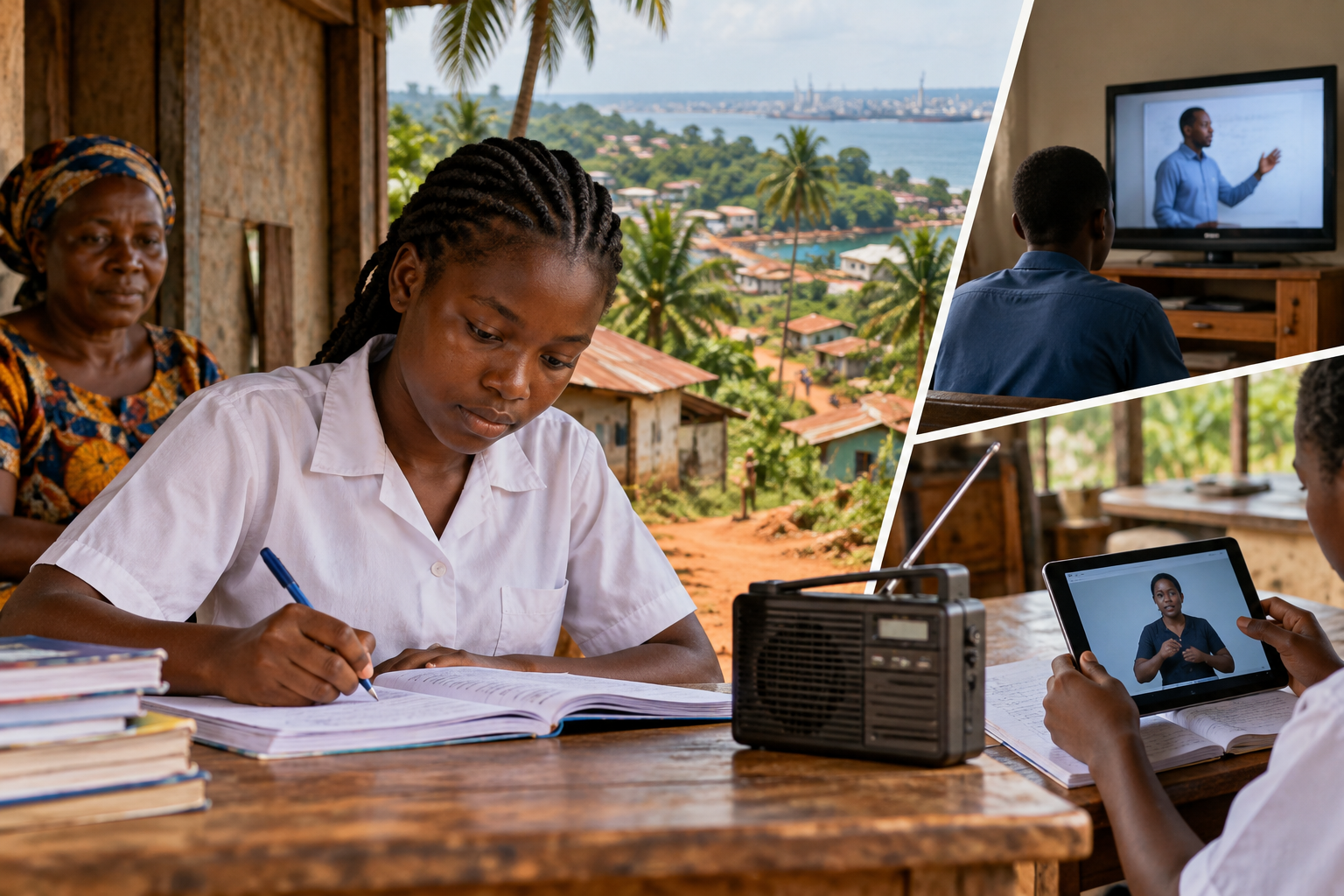
Digital Learning Must Account for Unequal Access
Ghana's pandemic response shows that effective digital education must be designed for unequal access, a lesson Liberia can apply by blending online, offline, and broadcast methods to ensure no student is left behind.

Digital Mentors Can Make Basic Skills More Accessible
Drawing lessons from a Rwandan community-based model, Liberia could pilot a 'Digital Mentor' program to build foundational tech skills, but its success must be measured by users' independent abilities, not just attendance.