
Digital Learning Must Account for Unequal Access
Ghana's pandemic response shows that effective digital education must be designed for unequal access, a lesson Liberia can apply by blending online, offline, and broadcast methods to ensure no student is left behind.
Editorial analysis. This piece reflects Executive Tea Chronicle's interpretation and editorial mission, not an official government position.
Analysis. Drafted from cited World Bank sources for editor review; Liberia proposals are the magazine's analysis, not source findings.
Source scope: the cited sources describe historical project designs and financing announcements (2021–2024), not verified current implementation outcomes. No new Liberia-specific factual evidence was checked for this draft; Liberia scenarios are hypothetical.
The promise of digital education is immense, offering a gateway to knowledge that transcends the physical classroom. Yet, in the rush to embrace technology, a critical oversight often occurs: the assumption of universal access. Simply making learning materials available online does not mean they are accessible to all. The digital divide, shaped by geography, infrastructure, and household income, remains a formidable barrier. For a national education strategy to succeed, it should be built not for an idealized, fully-connected student population, but for the one that actually exists, with its varied levels of access.
The challenge of bridging this gap is not theoretical. When the COVID-19 pandemic forced schools to close for ten months in Ghana starting in March 2020, it disrupted the education of an estimated 9.7 million students. The government’s response, however, provides a case study in designing for different circumstances. Rather than relying on a single channel, Ghanaian authorities implemented a multi-faceted remote learning plan that acknowledged the country's varied levels of connectivity.
What the comparison shows
Ghana’s strategy, supported by the World Bank’s International Development Association, was explicitly designed to address unequal access. A May 2022 World Bank article documents how the country’s Coordinated Education Response Plan went beyond simple online portals. Recognizing that many students, particularly in poor and rural households, faced challenges with access, the plan leveraged a mix of high-tech, low-tech, and no-tech solutions.
According to the World Bank's account, the Ghana Accountability for Learning Outcomes Project (GALOP) supported a broad range of initiatives:
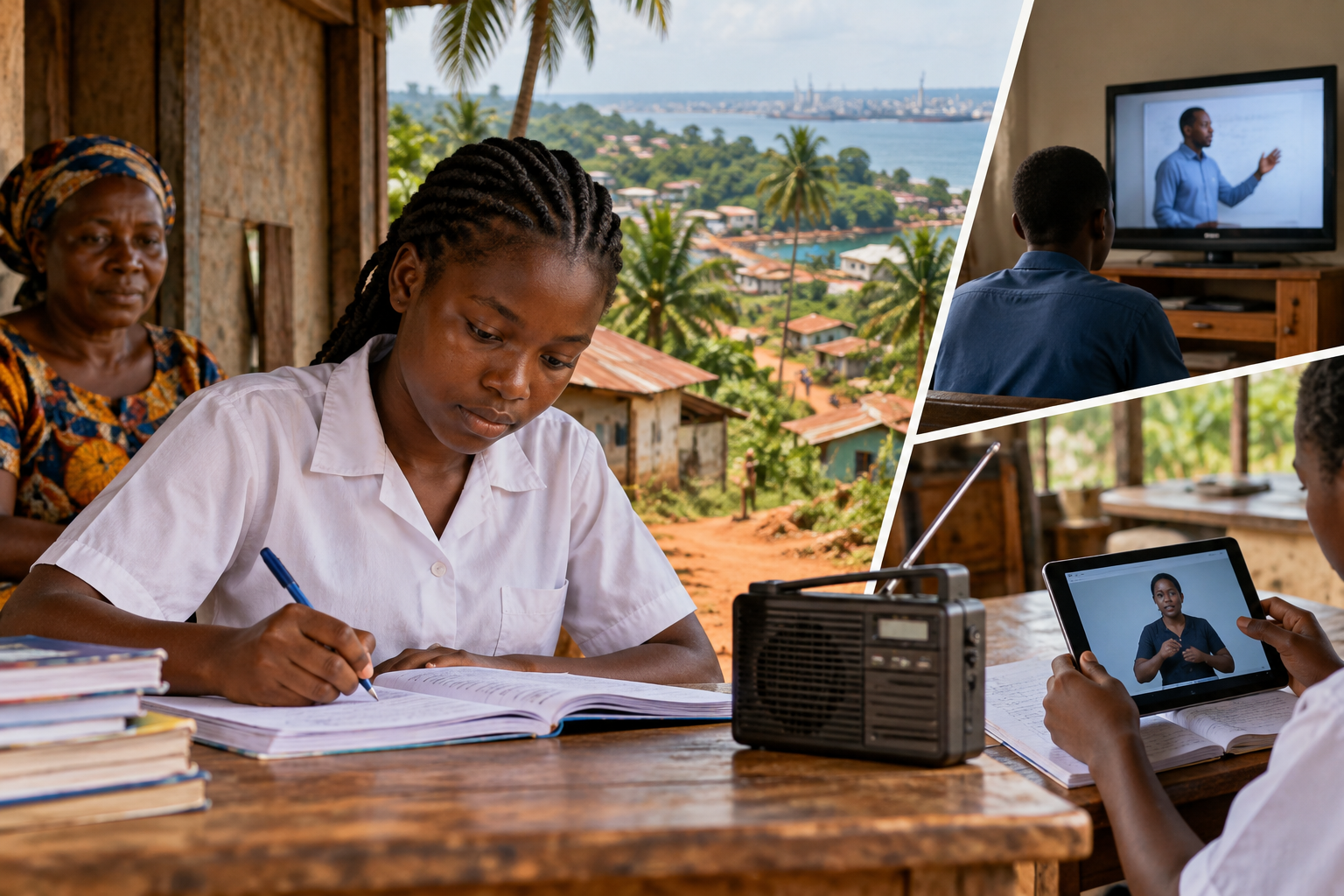
- Broadcast Media: Lessons were developed for Ghana Learning TV, a virtual classroom broadcast nationwide, with video lessons also made available online for those who could access them.
- Offline Materials: To reach students without reliable access to TV, radio, or internet, the project supported the distribution of printed teaching and learning materials for home learning.
- Blended Technology: A Learning Management System was developed for online learning to connect schools, teachers, and students. In a targeted initiative, a Ghana Education Service official noted that students with a learning disability or hearing impairment were provided with tablets pre-loaded with digital programs.
- Teacher and School Support: The approach was not just about content delivery. The World Bank report notes the project supported safe school reopening, student reentry, and training for teachers to help students catch up on what they missed. The project also provided daily school meals and sanitation kits to millions of children.
The project was designed to support a safe return to school in January 2021. This effort was part of a strategy that anticipated and actively worked to overcome barriers to access, rather than assuming they did not exist.
Analysis: applying the lesson in Liberia
Liberia can draw a vital lesson from this experience. A forward-looking national education plan could envision digital learning not as a monolithic online system, but as a hybrid ecosystem where different channels work together to promote learning continuity for all.
In a hypothetical example, a pilot program could be designed for a specific county, integrating several delivery methods. A tenth-grade student in a rural area might not have home internet, but her learning could still be structured. She might receive a printed packet of readings and worksheets, delivered to a central point in her community. Her teacher could then hold instructional sessions via a scheduled program on community radio, which can have broader reach than internet service in some areas. For more complex topics, video lessons could be downloaded onto a shared device at a local school or community hub for on-site viewing.
This model shifts the focus from passive content availability to active, structured learning. In another hypothetical example, a business with a reliable generator could serve as a community partner, offering a "learning hotspot" where students could download weekly lessons onto basic devices. The key is to design the system around the user's circumstances, creating multiple pathways to the same educational goals.
Tradeoffs and implementation risks
Of course, this approach is more complex than simply launching a website. It requires significant logistical coordination. Printing and distributing materials can be costly and depends on functional supply chains. A radio-based program would need a well-defined curriculum, a broadcast schedule, and a mechanism for student interaction. Teacher training would be paramount; educators would need to be equipped not just to use one platform, but to manage learning across multiple channels and support students who are engaging in different ways.
Furthermore, assessment becomes a major challenge. When a student fails to submit work, any monitoring system would need to distinguish between a failure of access—for example, a logistical delay in material delivery—and a failure to comprehend the material. This requires building support mechanisms directly into the program. Local coordinators or teachers would need a way to track participation across the different channels and follow up with students, diagnosing the root cause of any problem.
What global competence looks like here
This illustrates a principle of effective education policy. It is not about chasing the newest technology for its own sake, but about the thoughtful application of a range of tools to solve a real-world problem. A competent system is one capable of monitoring its own performance. It could track data on which students are accessing materials through which channels, helping to identify geographic or demographic cold spots where participation is low. This data could then inform targeted interventions, such as adjusting a distribution route or finding new ways to provide offline access.
Designing for access can also build resilience. A system that can deliver education through radio and print is not only more inclusive, but it is also more robust in the face of infrastructure disruptions, from power outages to internet service interruptions. It acknowledges that technology is only useful when it reliably reaches the learner.
Bottom line
For Liberia, the path to leveraging technology in education could be guided by pragmatism. The goal could be framed not as building a single online system that may only reach a fraction of the population, but as creating a resilient hybrid system accessible to all. The experience in Ghana, as documented by the World Bank, shows that it is possible to use technology to support learning without widening inequality. By deliberately planning for a mix of online, broadcast, and offline delivery, it is possible to build an education system that is more inclusive, more resilient, and ultimately, more effective for every Liberian child.
Sources
- Ghana: Online Education for Delivering Learning Outcomes during the COVID-19 School Closure — World Bank, published 2022-05-16
Related reading
Training Should Begin With the Work Employers Need
To bridge the skills gap, Liberia's training programs should be redesigned around specific, employer-defined tasks, transforming certificates into verifiable portfolios of competence that businesses can trust.

Young Professionals Need Evidence of Competence
To bridge the gap between academic credentials and employer needs, Liberia should adopt portfolio-based assessments where young professionals produce vetted, real-world work as tangible evidence of their competence.
Digital Mentors Can Make Basic Skills More Accessible
Drawing lessons from a Rwandan community-based model, Liberia could pilot a 'Digital Mentor' program to build foundational tech skills, but its success must be measured by users' independent abilities, not just attendance.