
Export Readiness Begins With Reliable Business Records
To compete globally, Liberian firms must first build operational discipline through reliable digital records, a lesson highlighted by a development project design in Burkina Faso.
Editorial analysis. This piece reflects Executive Tea Chronicle's interpretation and editorial mission, not an official government position.
Analysis. Drafted from cited World Bank sources for editor review; Liberia proposals are the magazine's analysis, not source findings.
Source scope: the cited sources describe historical project designs and financing announcements (2021–2024), not verified current implementation outcomes. No new Liberia-specific factual evidence was checked for this draft; Liberia scenarios are hypothetical.
For entrepreneurs aiming to export goods to international markets, a significant hurdle can be meeting buyer requirements. While a product, such as an agricultural good or an artisanal craft, may have appeal, the transition from local to international sales often depends on more than product quality alone. A key factor can be the ability to demonstrate the producing business's reliability.
International trade is built on trust, which in a commercial context is established through evidence. A potential buyer in another country needs assurance that a large order will be delivered on time and to the same specification as an initial sample. Without a documented history of production, quality control, and order fulfillment, any business asks a foreign partner to take a significant commercial risk. This suggests that a crucial part of export readiness is the internal discipline of keeping good business records.
A development strategy designed for a West African neighbor offers a potential model. An April 2023 World Bank project appraisal document for Burkina Faso outlines a project that connects enterprise technology, workforce skills, and business capability. Analyzing this design could offer insights relevant to Liberia's economic context.
What the comparison shows
The approach outlined for Burkina Faso is a structured plan. According to a World Bank project appraisal document from April 2023, the stated goal of the country's Entrepreneurship, Skills, and Technology Project is to increase access for micro, small, and medium-sized enterprises (MSMEs) to finance, technology, and a better-trained workforce. The project's design is instructive because it treats these elements as interconnected.
Two components of the project design are particularly relevant. One sub-component is designed specifically for strengthening MSME capabilities and technology adoption. This objective acknowledges that having a business is not enough; the business must have internal systems to operate efficiently and demonstrably. Another core component aims to develop a productive and entrepreneurial labor force. This involves improving formal technical and vocational training (TVET) and creating recognized training opportunities for low-skilled youth. The analysis behind the project design suggests that technology is of limited use without skilled people to operate it, and that skilled people are most effective in a well-organized business environment. It frames operational competence not as a byproduct of success, but as a prerequisite for it.
Analysis: applying the lesson in Liberia
This integrated approach provides a useful framework for analysis in Liberia. Enterprise assistance initiatives could be designed to reward the development of operational discipline. In such a model, a primary goal would be to help a firm build an auditable track record, which could in turn unlock future financing and commercial opportunities.
Adopting such practices would not necessarily require complex or expensive enterprise software. It can start with basic digital tools.
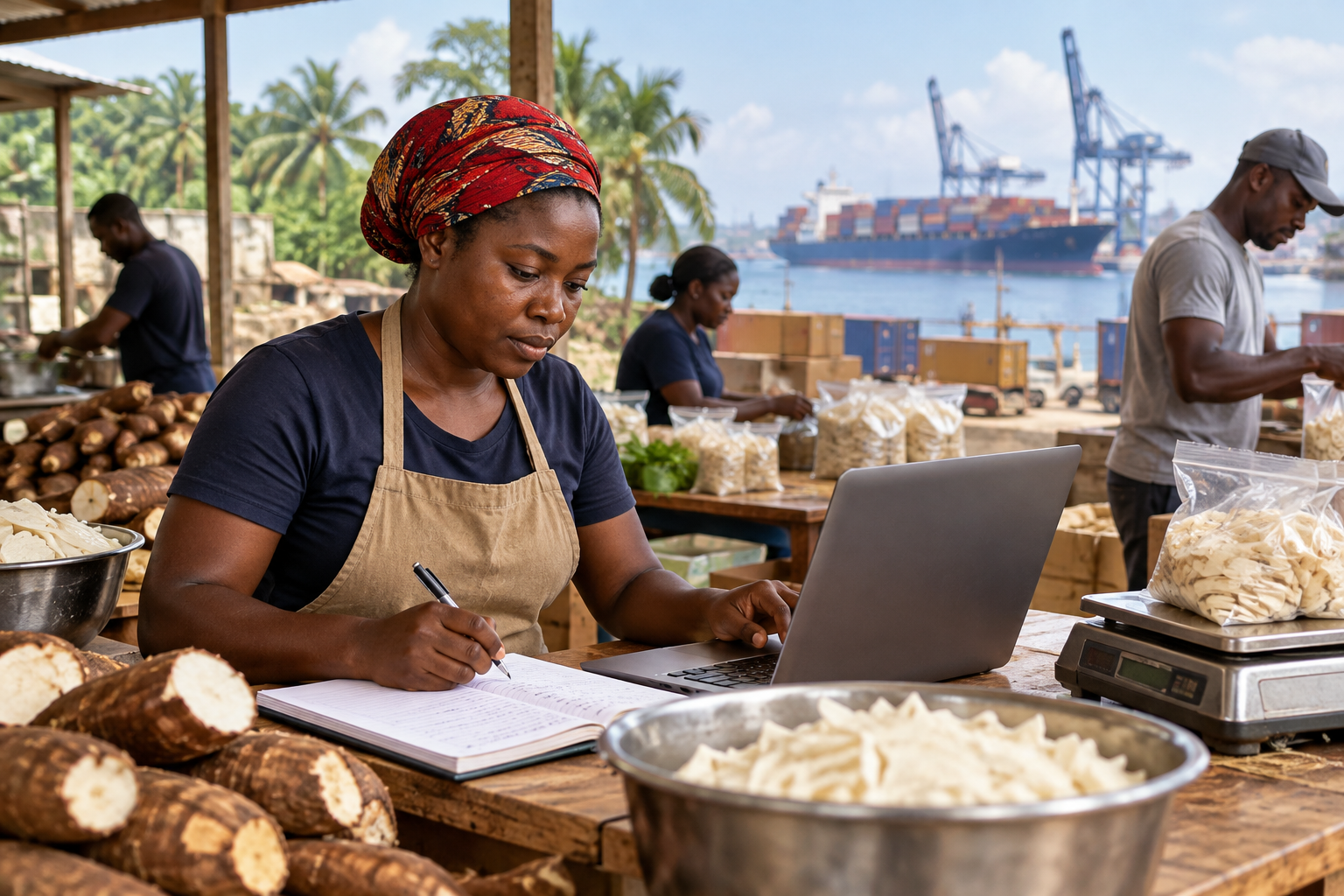
- In a hypothetical example, a cassava processor might use a simple spreadsheet to log the weight and source of each raw material delivery, the output of each processed batch, spoilage rates (at an illustrative rate of 3%), and the fulfillment time for every local order. This data, collected over months, becomes hard evidence of production capacity and reliability.
- Similarly, a hypothetical wholesaler of artisanal textiles could use a database to track inventory by pattern, record payments to suppliers, and monitor sales trends. When a potential buyer asks if they can supply 200 specific pieces within six weeks, they can answer with a data-backed projection, not a hopeful guess.
The core principle is to shift the focus from merely making a product to documenting the process. This internal data is the raw material for building trust with an external partner. It allows a business to prove its capabilities, manage its growth, and price its products based on real costs.
Tradeoffs and implementation risks
Implementing such a strategy would face challenges. A common risk in programs promoting digital tools is a potential gap in digital literacy. Some business owners may require support to adopt new tools effectively. This suggests that any related initiative would need to incorporate hands-on, practical training relevant to specific business operations, rather than generic computer classes.
Potential costs could be another barrier. While some software is free, the necessary hardware and internet connectivity for certain tools represent an expense. Furthermore, a common challenge is that business owners operate with limited time. To encourage adoption, the value of new administrative tasks would need to be clear and relatively immediate, as a distant prospect like a future export contract might not be a sufficient incentive. One hypothetical approach could be to link the adoption of record-keeping practices to more tangible, near-term benefits, such as qualifying for specific financing or local procurement opportunities.
What global competence looks like here
Ultimately, this approach suggests a specific definition of global competence for a firm. In this view, competence is less about marketing materials and more about the ability to respond to a detailed buyer inquiry with accuracy and confidence. It is being able to answer questions such as: What is your weekly production capacity? What were your quality control failure rates for the last quarter? Can you document your supply chain?
Reliable business records are a primary means of providing credible answers to such questions. From this perspective, a key milestone on the path to becoming an exporter is the successful completion of a potential buyer's due diligence questionnaire. Preparing a credible, defensible quotation is a direct result of this internal capacity. Following this logic, enterprise assistance could be geared toward helping firms reach this milestone.
Bottom line
Increasing participation in the global marketplace is a widely recognized goal for economic development. A strategic consideration is how to build the necessary foundation for export success. The analysis of the project design in Burkina Faso suggests that a focus on domestic business fundamentals can be critical. It highlights that capability can be seen as a synergy of skilled people, appropriate technology, and disciplined processes. For any business, the path to exporting can be strengthened by the foundational act of keeping good records, which provides the evidence that it is ready to engage with international partners.
Sources
- Burkina Faso - Entrepreneurship, Skills, and Technology Project (Project Appraisal Document, P177005) — World Bank, published 2023-04-17
Related reading

Investor Confidence Begins With Verifiable Information
To attract serious capital, Liberia must make its investment process more transparent; a public portal with verifiable project data, inspired by Rwanda's digital agenda, could be the key to building investor confidence.
Broadband Should Be Evaluated as Economic Infrastructure
To unlock durable growth, Liberia must evaluate broadband not as a consumer utility but as strategic economic infrastructure, prioritizing productive hubs and measurable business outcomes based on regional models.
Small Businesses Need Technology They Can Afford to Maintain
Supporting Liberia's small businesses requires more than just software; it demands an integrated approach that pairs affordable technology with financial access and hands-on training to solve real operational problems.