
Small Businesses Need Technology They Can Afford to Maintain
Supporting Liberia's small businesses requires more than just software; it demands an integrated approach that pairs affordable technology with financial access and hands-on training to solve real operational problems.
Editorial analysis. This piece reflects Executive Tea Chronicle's interpretation and editorial mission, not an official government position.
Analysis. Drafted from cited World Bank sources for editor review; Liberia proposals are the magazine's analysis, not source findings.
Source scope: the cited sources describe historical project designs and financing announcements (2021–2024), not verified current implementation outcomes. No new Liberia-specific factual evidence was checked for this draft; Liberia scenarios are hypothetical.
For small and growing businesses, the path to stability can be blocked by basic operational hurdles. Inconsistent inventory records can lead to stockouts or spoilage, while an unclear cash position can make it difficult to plan for expenses or seek credit. A common pitfall for both entrepreneurs and support programs is to view technology as a standalone solution: purchase new equipment, install software, and assume the problems will resolve themselves. This approach often falls short. A tool is only as good as the process it supports and the person who uses it.
Progress in this area comes from treating technology not as a standalone fix, but as one part of a comprehensive strategy. The goal should be to build durable business capacity, not just to purchase assets. This involves connecting the adoption of new tools with access to finance and the workforce training needed to make them effective. An examination of how development partners have designed support programs elsewhere reveals a more integrated model, one that offers a useful framework for how Liberia might cultivate a more resilient small-enterprise sector.
What the comparison shows
A useful framework for this integrated approach can be seen in a project design for Burkina Faso. According to a World Bank project appraisal document from April 2023, the stated development objective of the Entrepreneurship, Skills, and Technology Project for Burkina Faso is to increase access for micro, small, and medium-sized enterprises (MSMEs) to finance, technology, and a better-trained workforce. The project’s design explicitly links these three pillars, rather than addressing them in isolation.
The plan detailed in the document consists of several interconnected components. One component aims to strengthen the overall environment for business, which includes a specific sub-component for strengthening MSME capabilities and technology adoption. This is paired with another major component intended to improve access to finance, partly by expanding the reach of a partial credit guarantee facility, an instrument designed to de-risk lending to small businesses. The project design does not stop there. A third component is dedicated to developing a productive and entrepreneurial labor force. According to the project document, this involves supporting both formal technical and vocational education (TVET) and creating recognized, non-formal training opportunities for low-skilled youth. The project’s architecture implies that for technology adoption to succeed, firms need capital to invest and workers with the skills to operate the new systems.
Analysis: applying the lesson in Liberia
Applying this integrated lesson in the Liberian context would suggest a shift in how enterprise support is approached. Instead of only providing grants for equipment, a program could offer a package: a modest grant for technology paired with technical assistance. The focus would be on solving a specific, firm-defined problem, ensuring the technology is a means to an end.
The process could begin with the business identifying its primary operational challenge. A technology solution would be selected only after the problem is clearly understood. Consider these hypothetical scenarios:
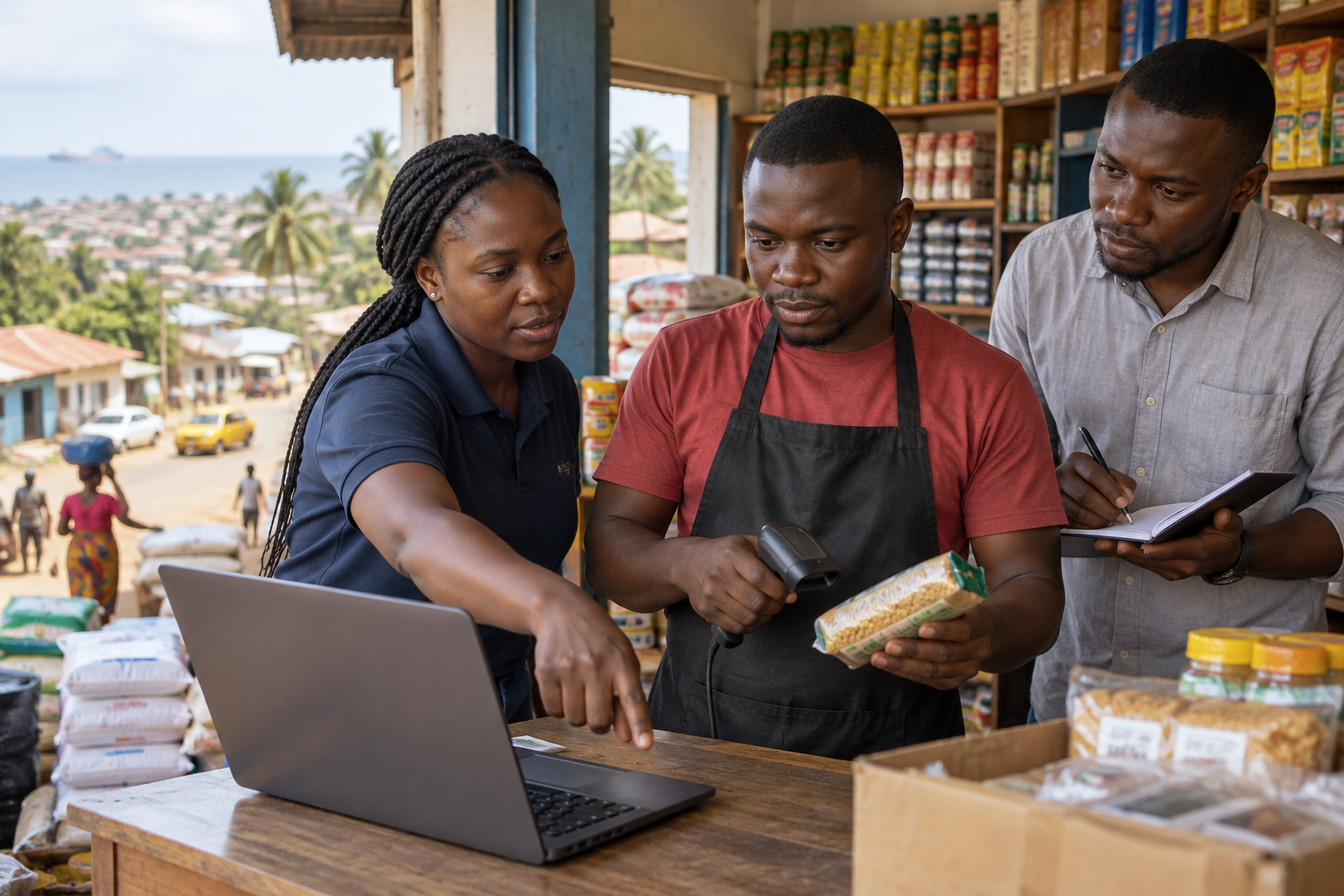
- A hypothetical wholesaler in Gbarnga might be losing money because they cannot track which products sell fastest, leading to overstocking of some items and understocking of others. A support program could help them acquire a simple barcode scanner and inventory management software. Crucially, the support would include an advisor who helps set up the system, digitize the initial product list, and train staff on how to scan items in and out.
- A hypothetical food processor in Buchanan seeking to sell to larger supermarkets may need to prove product consistency and safety. The core challenge could be a lack of production records. The right tool might be a simple software or even a structured spreadsheet system for logging batch numbers, ingredient sources, and production dates. The assistance would focus on implementing the record-keeping process that generates the documentation needed for quality certification.
- A hypothetical auto repair shop in Monrovia could be struggling with cash flow because of disorganized job tracking and billing. A simple job management application could help them schedule work, track parts ordered for each vehicle, and generate timely invoices. The training would focus on instilling the discipline of using the system for every single customer interaction.
In each case, the technology is secondary to the business process it enables. The value is not in the software, but in the improved management it facilitates.
Tradeoffs and implementation risks
This approach is not without risks. A primary challenge is sustainability. The technology chosen must be affordable for the business to maintain long after any program support ends. A complex, subscription-based system that a small firm cannot afford in year two is a failed investment. Simplicity and low ongoing cost are paramount.
Another risk is a one-size-fits-all mentality. A program must be flexible enough to cater to the diverse needs of a retailer versus a small-scale manufacturer or a service provider. A rigid selection process for technologies could lead to firms receiving tools that do not solve their core problem. Finally, impact requires follow-up. An effective program would need to track whether businesses continue to use the systems and whether their operating performance measurably improves, such as through better loan eligibility or reduced waste.
What global competence looks like here
For many small businesses, becoming “globally competent” does not necessarily mean launching an international website. More fundamentally, it means keeping clean, reliable, and verifiable records. It means being able to produce a profit-and-loss statement that a bank can trust and having inventory data that a larger commercial partner can use for planning. Professional record-keeping is the language of modern commerce. Without it, a business can remain locked in an informal, high-risk category, making it difficult to access financing or larger markets. By systematically adopting and maintaining appropriate technology, small firms in Liberia can begin speaking that language, turning themselves from opaque risks into credible, investable opportunities.
Bottom line
To meaningfully strengthen Liberia’s private sector from the ground up, any strategy should consider moving beyond piecemeal interventions. Providing a laptop to a small business is an expense; teaching that business how to use a financial management tool to potentially secure a commercial loan is an investment. The design philosophy evident in the Burkina Faso project—integrating technology with skills and finance—provides a coherent model to consider. A support program built on this foundation could equip entrepreneurs in Liberia not just with tools, but with the capacity to build businesses that last.
Sources
- Burkina Faso - Entrepreneurship, Skills, and Technology Project (Project Appraisal Document, P177005) — World Bank, published 2023-04-17
Related reading

Investor Confidence Begins With Verifiable Information
To attract serious capital, Liberia must make its investment process more transparent; a public portal with verifiable project data, inspired by Rwanda's digital agenda, could be the key to building investor confidence.
Broadband Should Be Evaluated as Economic Infrastructure
To unlock durable growth, Liberia must evaluate broadband not as a consumer utility but as strategic economic infrastructure, prioritizing productive hubs and measurable business outcomes based on regional models.
Digital Finance Must Solve a Commercial Problem
Kenya’s integrated digital strategy shows that for Liberia, the true test of financial technology is not just access, but whether it solves real-world commercial problems for businesses, reducing friction and increasing reliability.