
Rural Enterprise Deserves a Place in Digital Investment
Burkina Faso's new digital strategy offers a key lesson for Liberia: true economic modernization requires intentionally designing investments to serve rural enterprises and communities from the very beginning, not as an afterthought.
Editorial analysis. This piece reflects Executive Tea Chronicle's interpretation and editorial mission, not an official government position.
Analysis. Drafted from cited World Bank sources for editor review; Liberia proposals are the magazine's analysis, not source findings.
Source scope: the cited sources describe historical project designs and financing announcements (2021–2024), not verified current implementation outcomes. No new Liberia-specific factual evidence was checked for this draft; Liberia scenarios are hypothetical.
Discussions about economic modernization often focus on investment in capital cities, envisioning new infrastructure and digital services concentrated in a single urban center. While important, such a vision can be incomplete. A development strategy that concentrates opportunity primarily in one area carries the risk of deepening economic divides. A path to modernization could instead focus on connecting a wider population to economic opportunity, not just those who live near traditional commercial hubs.
A 2024 development in West Africa offers a point of comparison for how this might be approached. In Burkina Faso, a new digital investment was designed with an explicit focus on populations that can be overlooked. This approach suggests that for digital transformation to be a tool for broad-based prosperity, it can be planned from its inception to reach rural areas and other communities. For a country like Liberia, this suggests that investments in the digital economy could be structured to serve agricultural traders, small-scale manufacturers, and local service providers in every region, whose participation is a component of sustainable national growth.
What the comparison shows
The choice to prioritize inclusion is visible in the design of Burkina Faso’s Digital Acceleration Project. According to a World Bank press release of 23 January 2024, the institution approved a $150 million credit from its International Development Association (IDA) for this operation. The project’s stated purpose is to improve access to digital infrastructure, public services, and skills for the broader population.
The project documents explicitly name rural communities and internally displaced persons as targeted beneficiaries. This can be contrasted with infrastructure investment models where benefits are expected to spread from a central point. The project aims to expand digital connectivity and accelerate the digital transformation of essential public services, such as those in education, health, and social protection. The World Bank announcement notes that the project intends to provide economic opportunities for these populations. The project is also designed to build on the achievements of previous initiatives, suggesting a long-term strategic approach.
The objectives, as described by the World Bank, include increasing access to broadband, fostering investment in the digital economy, training public administration staff, and providing young people with opportunities to gain digital skills and find jobs. The emphasis is on using digital technology to address fragility and build resilience, particularly in areas vulnerable to climate shocks. This framing—treating digital access as a core tool for economic resilience and inclusion—provides a potential framework for analysis in the Liberian context.
Analysis: applying the lesson in Liberia
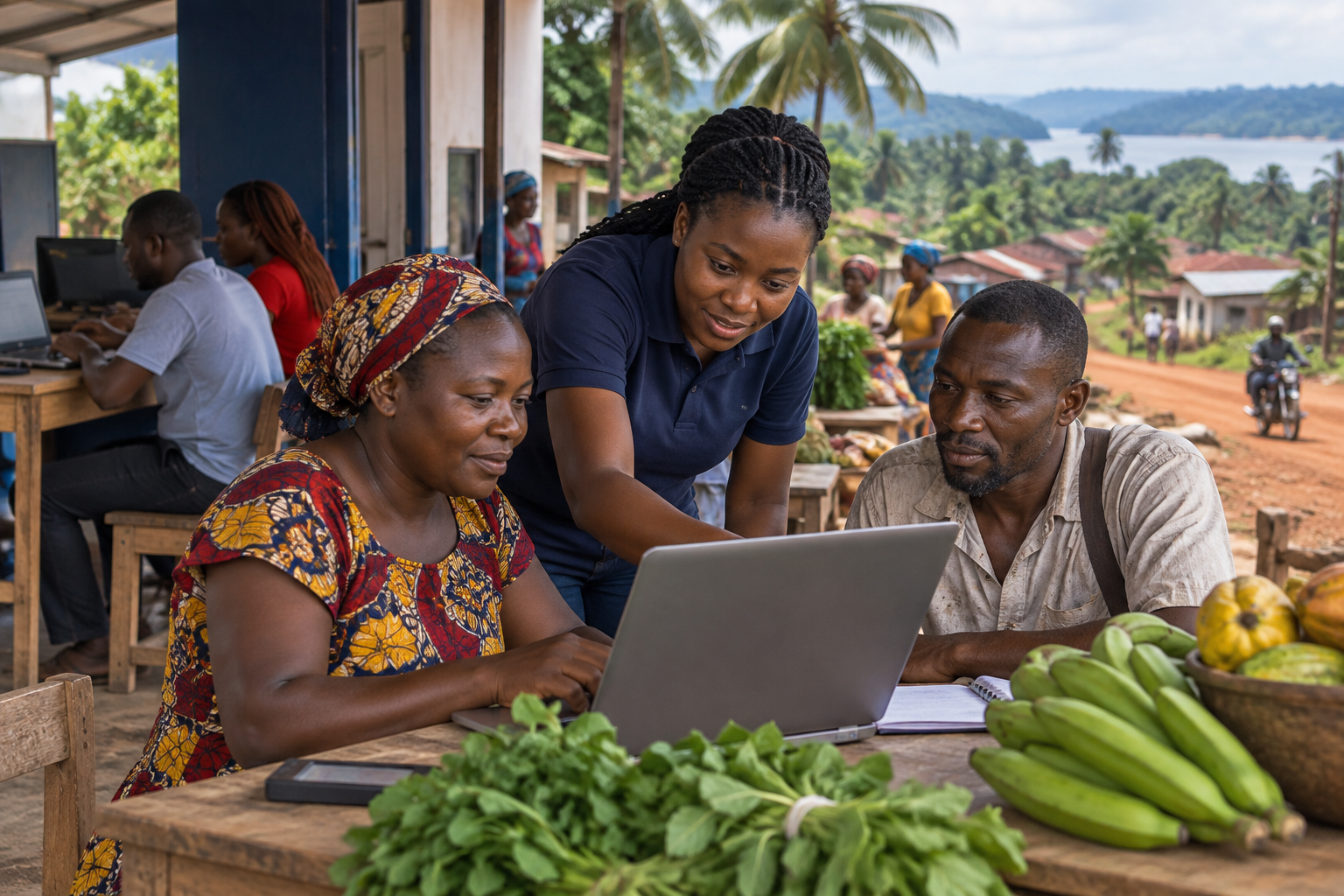
Applying this approach in Liberia could involve creating tangible points of access for rural enterprise. One potential model could be the establishment of county-level Enterprise & Innovation Hubs, physical centers that serve as a bridge to the digital economy for local businesses that may face barriers to affording or managing their own dedicated infrastructure.
These hubs could offer more than just internet access. Their value could lie in a suite of supported services, chosen through consultation with local business communities to ensure services meet diverse user needs. Core services could include:
- Shared Connectivity: Affordable, reliable internet access available on a walk-in or subscription basis.
- Assisted Digital Services: Staff trained to assist entrepreneurs with digital tasks. For example, in a hypothetical scenario where a business registry or tax authority offered online services, hub staff could guide users through the process.
- Business Development Access: Guided access to online resources for bookkeeping, marketing, or supply chain management, as well as information on digital financial services.
- Market Information: Access to platforms for market information, such as commodity pricing or supply chain logistics.
In a hypothetical example, a wholesaler in a rural county might use a hub to create a simple digital inventory, communicate with drivers, and receive mobile money payments from customers in a major urban center. Similarly, a group of artisans could receive assistance in photographing its products and marketing them online, potentially reaching customers far beyond the local market. The key is that these services would be supported, acknowledging that digital access often requires both tools and guidance.
Tradeoffs and implementation risks
This model is not without challenges. A primary risk in such projects is financial sustainability. Public funding could be required for establishment, but a long-term plan for operational costs would be necessary to ensure long-term viability and avoid derelict facilities. For any such project in Liberia, a key consideration would be energy supply. Ensuring a reliable power source, potentially through off-grid solutions like solar, would be critical and would add to upfront costs and maintenance needs.
Furthermore, there is a human capital risk. Finding, training, and retaining skilled staff to run such hubs in multiple counties could be a significant undertaking. Finally, even with a physical hub, there is a common risk of elite capture, where the most educated or well-connected individuals might dominate its use. Ensuring genuine access for small-scale farmers, local traders, and young entrepreneurs would require proactive outreach and program design that specifically targets their needs and schedules.
What global competence looks like here
Equipping rural entrepreneurs with these tools could redefine what it means to be globally competent in a local context. Competence in this sense is not just about high-level technical skills; it is the ability to access and use information to make better business decisions. It could be a farmer using digital tools to access weather information, a mechanic ordering parts online to avoid a long journey, or a community health worker using a digital device to access training materials.
These hubs could function as incubators for this practical, applied competence. They could help users solve local problems with global information, contributing to a more dynamic and resilient national economy. By decentralizing access to information and markets, innovation could flourish in many places, not just in a few areas of the capital.
Bottom line
The case of Burkina Faso's project design suggests a philosophy of intentional inclusion. Digital investment can be seen as a tool for equitable growth and broader economic development. To explore this, Liberia’s policymakers, with support from development partners, could design a digital future with the needs of rural enterprises at the forefront. Building a modern economy means working to ensure that the digital revolution delivers opportunity not just to a connected few, but to the determined many across all counties.
Sources
- Burkina Faso: Scaled-up Support for Digital Transformation — World Bank, published 2024-01-23
Related reading

Investor Confidence Begins With Verifiable Information
To attract serious capital, Liberia must make its investment process more transparent; a public portal with verifiable project data, inspired by Rwanda's digital agenda, could be the key to building investor confidence.
Broadband Should Be Evaluated as Economic Infrastructure
To unlock durable growth, Liberia must evaluate broadband not as a consumer utility but as strategic economic infrastructure, prioritizing productive hubs and measurable business outcomes based on regional models.
Small Businesses Need Technology They Can Afford to Maintain
Supporting Liberia's small businesses requires more than just software; it demands an integrated approach that pairs affordable technology with financial access and hands-on training to solve real operational problems.