
Digital Finance Must Solve a Commercial Problem
Kenya’s integrated digital strategy shows that for Liberia, the true test of financial technology is not just access, but whether it solves real-world commercial problems for businesses, reducing friction and increasing reliability.
Editorial analysis. This piece reflects Executive Tea Chronicle's interpretation and editorial mission, not an official government position.
Analysis. Drafted from cited World Bank sources for editor review; Liberia proposals are the magazine's analysis, not source findings.
Source scope: the cited sources describe historical project designs and financing announcements (2021–2024), not verified current implementation outcomes. No new Liberia-specific factual evidence was checked for this draft; Liberia scenarios are hypothetical.
Discussions about digital finance often focus on financial inclusion, with the goal of bringing more people into the formal financial system, primarily through the adoption of mobile money accounts. While this is an important foundation, a focus on individual enrollment risks overlooking a key element: an economy does not grow simply because more people have digital wallets, but rather when those wallets make commerce easier, cheaper, and more reliable. The significant opportunity lies not just in participation, but in improving the velocity and efficiency of transactions.
The central question could therefore be broadened. Instead of only asking how to provide an individual with a digital account, analysis could focus on how such an account might solve pressing business challenges. For example, could a digital system reduce the risk of theft? Could it create a reliable record of sales? Could a supplier in one county use it to get paid by a customer in another without ambiguity or high fees? Unless digital tools can provide clear, affirmative answers to such commercial questions, they may not become a cornerstone of economic development.
An initiative announced in Kenya in 2023, while focused on different sectors, offers a lesson in strategic design. By bundling infrastructure, services, and skills into a single program, it provides a framework for thinking about systemic transformation. For Liberia, the lesson is not to copy the project, but to consider adopting an integrated mindset and applying it to the friction points within its own commercial landscape.
What the comparison shows
In April 2023, the World Bank announced its board had approved a major investment in Kenya’s digital economy. According to a press release from April 5, 2023, the financing consists of $390 million for the first phase of the Kenya Digital Economy Acceleration Project. This initial phase, planned to run from 2023 to 2028, is part of a multi-phase program intended to deliver a comprehensive upgrade to the country’s digital ecosystem.
The project’s stated objectives are notably interconnected. It aims to expand access to high-speed internet, improve the quality of education and selected government services through digitization, and build the population's digital skills. A key goal, according to the World Bank, is to shrink the “digital divide” and make economic growth more equitable. The plan involves practical infrastructure targets, including increasing last-mile broadband connectivity for over 70% of the population in rural and underserved areas and expanding the fiber optic network. The project also intends to leverage private investment, aiming to mobilize an estimated $100 million in private capital for this infrastructure build-out.
This is designed not merely as a technology project, but as an economic strategy. The World Bank release noted that Kenya’s own ‘ICT Master Plan’ aims to digitize 80% of public services and transform the country into a regional hub. The project supports this by linking physical connectivity (fiber optics), service delivery (e-government), and human capital (skills training) together. This holistic approach recognizes that infrastructure is of little use if people lack the skills to use it, and digital services cannot be delivered without reliable, widespread connectivity.
Analysis: applying the lesson in Liberia
Applying this integrated logic in a Liberian context would mean focusing on the transactional realities of small and medium-sized businesses. A potential area for analysis is the availability of business-grade tools that could make digital payments more trustworthy and efficient. Liberia could explore a program that links interoperability standards, merchant tool development, and business-centric financial literacy.
In a hypothetical scenario, a wholesaler in a regional hub supplies goods to retailers in a major city. A key challenge in such a business can be reconciling payments. If the business receives dozens of individual mobile money transfers, a bookkeeper might have to manually match transaction codes from SMS notifications to specific invoices, a process that can be time-consuming and prone to error. A well-designed digital system could provide a simple merchant dashboard. From a phone, the business owner could see a list of incoming payments, with sender information and reference numbers that correspond directly to invoices. The system could generate a settlement report with one tap, simplifying accounting and helping to create the clean financial records often needed to access a bank loan.
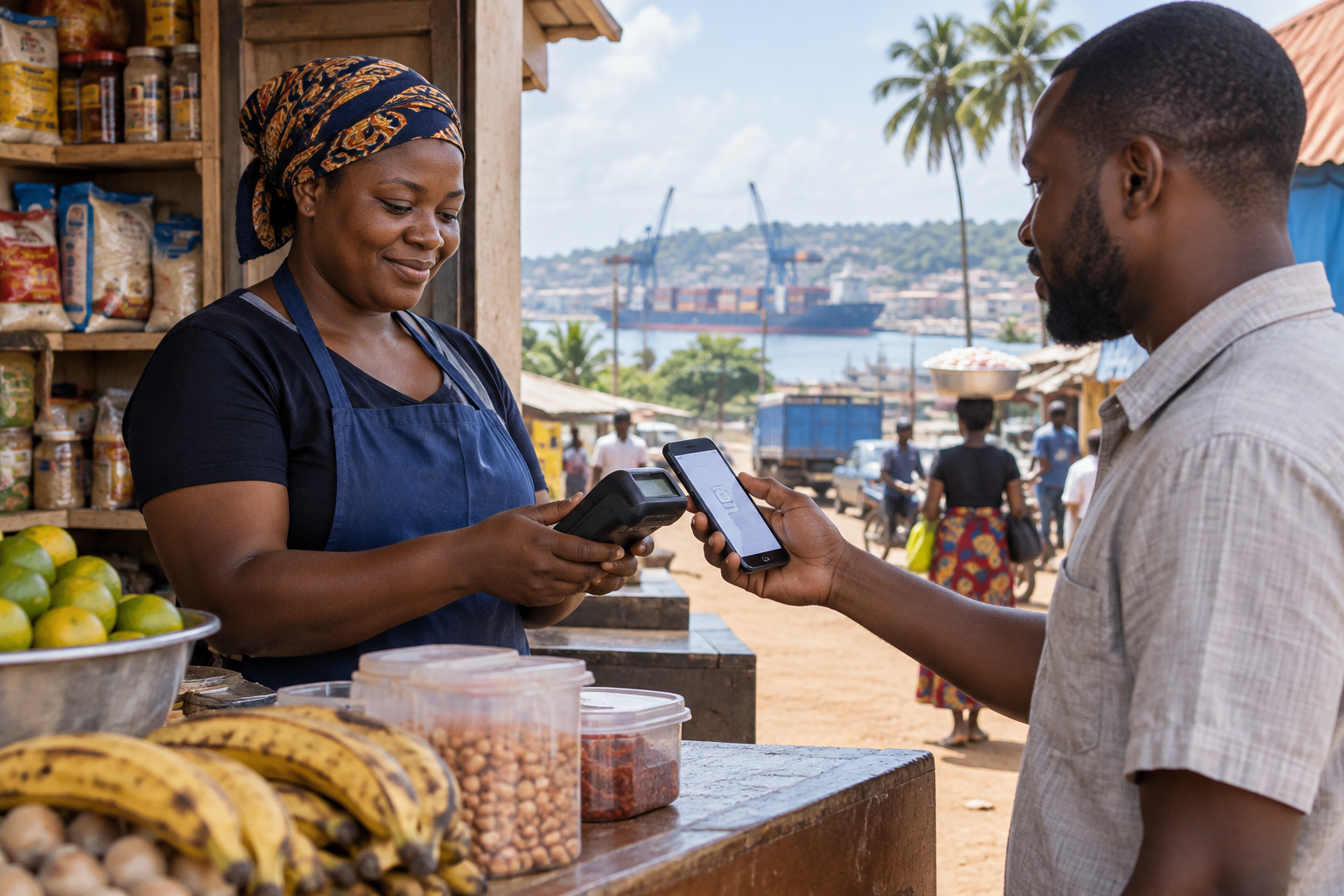
Or, in another hypothetical example, a market trader in a busy commercial district may have customers who use different mobile money providers. To avoid losing a sale, a merchant might need separate devices or SIM cards for each service, and must manage the different fee structures. An integrated approach would promote interoperability at the point of sale. A single, simple terminal—or even a USSD-based interface—could accept payments from any provider. Ideally, the system would show the merchant the exact amount they will receive after fees before accepting the payment, and provide a clear confirmation to both parties. Crucially, it could include a simple, standardized process for handling errors, such as an incorrect payment amount.
A government’s role would not necessarily be to build such a system, but to act as a catalyst and regulator. It could work with service providers to establish the technical and legal frameworks for interoperability, ensuring a payment from one network can be seamlessly processed by a merchant using another. This can foster competition while creating a unified, predictable experience for businesses.
Tradeoffs and implementation risks
This approach is not without challenges. Mandating interoperability can be technically and commercially complex, as it may require cooperation between business rivals. There is a risk that a unified payment system could lead to standardized, and potentially higher, fees if not properly regulated. Policymakers would need to ensure that any new system does not become a gatekeeper that imposes another layer of costs on businesses. Furthermore, as transactions become more centralized, cybersecurity becomes a critical national concern. A system designed for larger businesses might be too expensive or complicated for the smallest micro-enterprises, potentially worsening the divide it seeks to close. Implementation would likely need to be phased and flexible, starting with pilots that allow for learning and adjustment.
What global competence looks like here
Observing Kenya's strategy is an exercise in analysis. It does not suggest importing a project wholesale, but rather identifying the underlying principle—an integrated approach to ecosystem development—and adapting it to solve a distinct problem. While the Kenya project includes a focus on strengthening public service delivery, a different country might determine its most urgent need is to reduce friction in private commercial transactions. Progress can lie in this type of intelligent adaptation, not mimicry. A competent strategy would aim to strengthen the domestic economy by solving problems that local businesses face, using principles that have been part of program designs elsewhere.
Bottom line
Expanding digital finance in Liberia may yield transformative economic benefits if it is aimed squarely at the problems of commerce. An ultimate measure of success is not just the number of digital wallet accounts, but whether a business owner in one part of the country can trade with a partner in another more reliably, more quickly, and with greater transparency. By considering an integrated strategy focused on interoperable business tools, clear standards, and practical training, Liberia can work to ensure that its digital future is built on a foundation of real, tangible commercial utility. That is a form of financial inclusion that could meaningfully drive development.
Sources
- Kenya and the World Bank Group Provide a $390 Million Boost the Digital Economy — World Bank, published 2023-04-05
Related reading

Investor Confidence Begins With Verifiable Information
To attract serious capital, Liberia must make its investment process more transparent; a public portal with verifiable project data, inspired by Rwanda's digital agenda, could be the key to building investor confidence.
Broadband Should Be Evaluated as Economic Infrastructure
To unlock durable growth, Liberia must evaluate broadband not as a consumer utility but as strategic economic infrastructure, prioritizing productive hubs and measurable business outcomes based on regional models.
Small Businesses Need Technology They Can Afford to Maintain
Supporting Liberia's small businesses requires more than just software; it demands an integrated approach that pairs affordable technology with financial access and hands-on training to solve real operational problems.