
Connectivity Planning Should Include Reliable Power
Inspired by Ghana's digital push, Liberia should integrate reliable power planning into its connectivity strategy to ensure that investments in new technology are consistently usable and deliver real economic value.
Editorial analysis. This piece reflects Executive Tea Chronicle's interpretation and editorial mission, not an official government position.
Analysis. Drafted from cited World Bank sources for editor review; Liberia proposals are the magazine's analysis, not source findings.
Source scope: the cited sources describe historical project designs and financing announcements (2021–2024), not verified current implementation outcomes. No new Liberia-specific factual evidence was checked for this draft; Liberia scenarios are hypothetical.
The drive for digital transformation across Africa presents an opportunity for economic development, promising to connect businesses to new markets, streamline public services, and create avenues for innovation. For any country developing its digital strategy, it is useful to look at ambitious regional examples. In Ghana, a country whose digital economy grew significantly between 2014 and 2020, a World Bank diagnostic from 2020 described it as among the digital leaders in Sub-Saharan Africa. Examining such large-scale plans highlights a critical question: once a facility has internet access, what is required to keep it operational?
The most sophisticated digital tools rely on a stable electrical supply. In any setting where the electrical grid may be unreliable, a strategy focused solely on delivering connectivity, without a parallel plan for ensuring power, risks being ineffective. Functional digital access is not only about the theoretical presence of a signal, but about the practical ability of a user to consistently operate a powered device to connect to it.
This suggests that planning for connectivity could also incorporate planning for service uptime. A key consideration for policymakers and their development partners would be to treat reliable power not as a secondary concern, but as an integral component of a digital infrastructure project from its inception.
What the comparison shows
An examination of Ghana’s strategy reveals the scale of modern digital investment. According to a World Bank press release from April 28, 2022, the institution approved $200 million in financing for the Ghana Digital Acceleration Project. The project’s stated goals are comprehensive. It was expected to increase access to mobile internet and broadband for six million people, partly by encouraging private sector investment in last-mile connectivity for underserved rural areas. The initiative was designed to build on previous work, including the e-Transform Ghana project.
The project design described by the World Bank extends beyond simple access. It was intended to enhance the efficiency and quality of selected digital public services and continue the work of prior projects. Furthermore, the 2022 plan included strengthening the local digital innovation ecosystem by supporting startups, expanding access to early-stage financing, and promoting advanced digital skills. A key feature of the project’s design is its stated goal to promote digital inclusion for women, persons with disabilities, and rural communities. While the financing announcement outlines a framework for expanding digital networks and services, it does not detail provisions for the electrical power required to run the devices that would use this new connectivity.
Analysis: applying the lesson in Liberia
A country could analyze the core of such digital ambitions while innovating on implementation. By integrating energy planning into connectivity projects, it may be possible to create a more resilient and impactful digital ecosystem. This would mean assessing the power needs of a target location, such as a school or clinic, at the same time its networking requirements are evaluated.
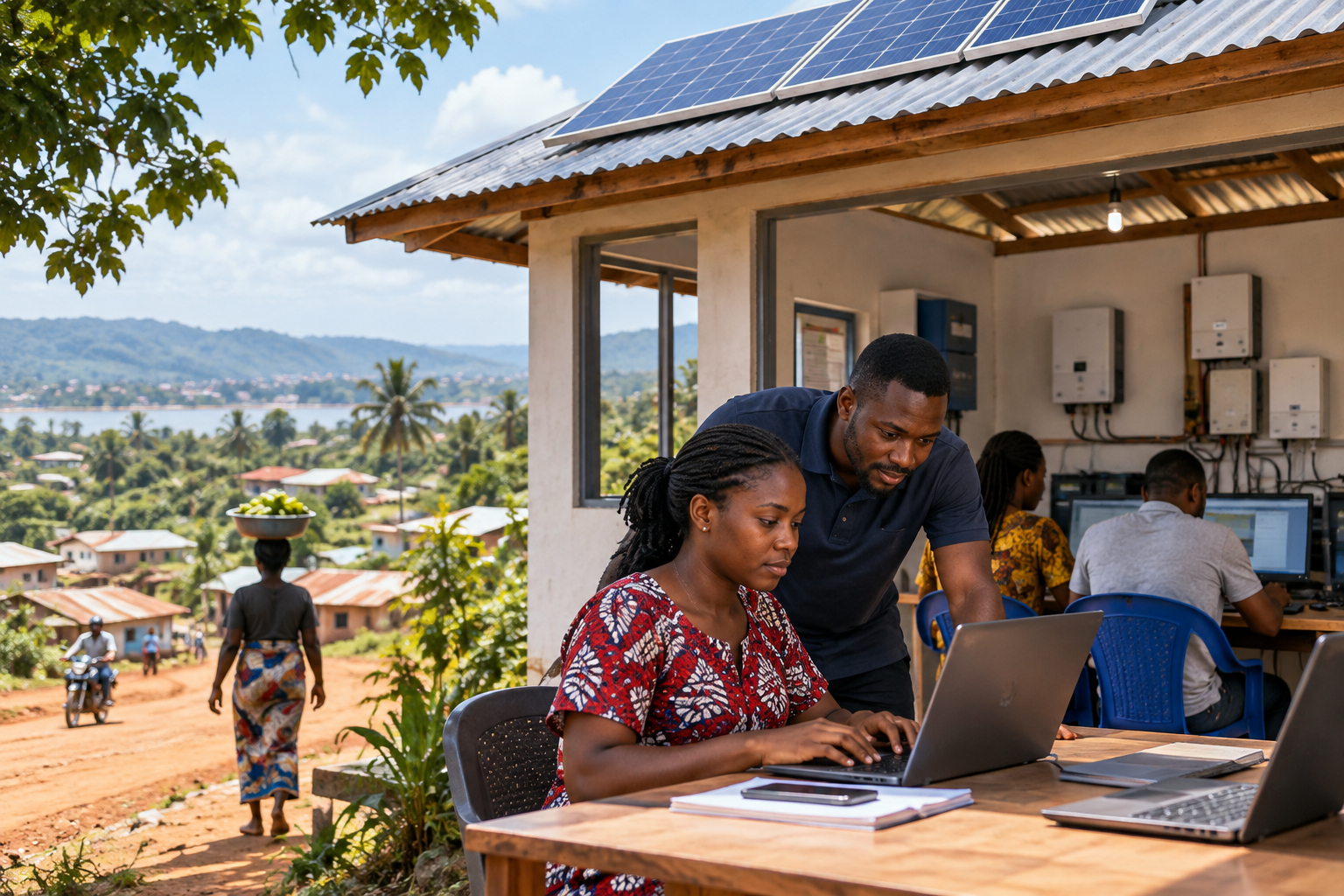
The solutions could vary in scale and cost. In a hypothetical example, a community business center in Ganta could be designed with a solar panel and battery storage system capable of running a satellite internet terminal and several computers. While this adds to the upfront project cost, it could transform the center from a resource with limited availability into a more consistently accessible service. Similarly, a hypothetical agricultural cooperative in Nimba County might use a new digital platform to track inventory, but its utility would depend on a stable power source. A small generator or an inverter system could significantly affect its value to users.
One potential approach is for project proposals to include a section on “service uptime,” detailing a backup power solution, its capacity, and its estimated operational cost. This approach encourages a more holistic view of what constitutes a complete and functional installation.
Tradeoffs and implementation risks
This integrated approach is not without challenges. The most obvious tradeoff is increased upfront cost. Including solar panels, batteries, or generators in a project budget will make each installation more expensive than one focused on connectivity alone. However, this initial expense can be weighed against the long-term risk of underutilized infrastructure if power is not consistently available.
Maintenance presents another significant risk. Backup power systems require upkeep. Solar panels must be kept clean, batteries have a finite lifespan, and generators need fuel and regular servicing. A clear plan for long-term maintenance, including funding and designated local responsibility, is an important factor. Without such a plan, a well-designed system could fall into disrepair.
Furthermore, staff at connected locations would need training not only on the digital tools but also on the power systems. This might include how to protect electronics from power surges, perform basic troubleshooting on backup equipment, and identify when to call for technical support. This human capital component is as critical as the hardware itself.
A Broader View of Success
An effective development strategy recognizes the deep-seated dependencies that make a system function. This involves designing and building resilient, appropriate systems rather than simply deploying isolated technologies in environments that may not fully support them.
Following this logic, success could be measured differently. Instead of tracking only the number of “connected” facilities, a complementary metric could be the number of dependable hours of service each facility provides. For an investment in a rural school, for instance, a key performance indicator might be how many hours a day students and teachers can actually use powered computers to access an internet link. A shift in metrics—from installation counts to uptime—could help orient investment toward what creates tangible and consistent value.
Bottom line
Ghana’s 2022 project financing for expanding broadband access and digital services offers an informative model for national development. For any country facing similar challenges, the analysis suggests an opportunity to build upon such models by systematically addressing the foundational constraint of reliable power. Bundling energy solutions with connectivity infrastructure may help avoid the pitfall of creating a digital ecosystem that is vulnerable to power interruptions. In this view, integrating power and connectivity is an essential consideration for ensuring that investments in a digital future can yield a sustained and accessible return.
Sources
- World Bank Provides $200 Million to Accelerate Ghana’s Digital Transformation Agenda for Better Jobs — World Bank, published 2022-04-28
Related reading
Design Digital Services Around a Completed Transaction
Inspired by the design of Rwanda's digital agenda, Liberia's public agencies should build online services that deliver a complete result, not just collect an application, to truly modernize and respect citizens' time.

Shared Data Standards Can Reduce Administrative Friction
Kenya’s plan for a data-driven public sector shows how shared technical standards could reduce the administrative friction that slows Liberia’s economy, starting with a pilot project between key agencies.
Digital Inclusion Requires Assisted Access
For Liberia's digital services to succeed, the country must learn from international examples and build assisted access points to bridge the gap for citizens with limited literacy, devices, or connectivity.