
Digital Inclusion Requires Assisted Access
For Liberia's digital services to succeed, the country must learn from international examples and build assisted access points to bridge the gap for citizens with limited literacy, devices, or connectivity.
Editorial analysis. This piece reflects Executive Tea Chronicle's interpretation and editorial mission, not an official government position.
Analysis. Drafted from cited World Bank sources for editor review; Liberia proposals are the magazine's analysis, not source findings.
Source scope: the cited sources describe historical project designs and financing announcements (2021–2024), not verified current implementation outcomes. No new Liberia-specific factual evidence was checked for this draft; Liberia scenarios are hypothetical.
The push to digitize Liberia’s public services holds immense promise. A future where business permits, tax filings, and academic records are accessible online could reduce administrative burdens that can impede commerce and civic life. This vision of a streamlined, efficient digital government is compelling. Yet, a critical question remains: who might be left behind? True digital transformation is not measured by the sophistication of a government’s technology, but by the breadth of its reach into every community.
Simply launching a website or an app is not a solution when a significant portion of the population may face barriers of literacy, internet access, device ownership, or digital skills. A digital-first strategy that ignores this reality risks deepening the very inequalities it should be helping to solve. The goal cannot be to create a system that only works for urban or more connected populations. Instead, Liberia has an opportunity to design for inclusion from the very beginning. By looking at how other nations are approaching this challenge, Liberia can identify models for progress that are both ambitious and equitable.
A project announced for Burkina Faso provides an example of this inclusive mindset. It demonstrates that addressing the needs of the most vulnerable can be a central pillar of a national digital strategy, rather than an afterthought.
What the comparison shows
In West Africa, development partners are explicitly funding digital projects with inclusion at their core. According to a World Bank press release of 23 January 2024, the institution approved a $150 million Digital Acceleration Project for Burkina Faso. Financed by the International Development Association (IDA), the project’s stated purpose is to improve access to digital infrastructure, public services, and skills. Crucially, the project design reportedly goes beyond generic goals to specifically target several vulnerable populations, including internally displaced persons and rural communities.
The project’s scope, as described by the World Bank, includes several key components. It aims to accelerate the digital transformation of high-impact public services in sectors like education, health, and social protection. The project is also designed to build human capacity by training public administration staff and providing young people with opportunities to gain digital skills and find employment. A World Bank official was cited as noting the project aims to increase broadband connectivity, particularly in areas vulnerable to climate shocks and those hosting displaced persons. This initiative builds on the foundation of previous projects, demonstrating a long-term commitment to leveraging technology to strengthen resilience and create economic opportunities.
Analysis: applying the lesson in Liberia
The lesson for Liberia is not to copy another country’s project wholesale, but to adopt its guiding principle: proactively design for all potential users. This means building a bridge between the digital world and the daily reality of citizens who may lack digital access or skills. The most effective way to do this could be through a national network of assisted digital access points.
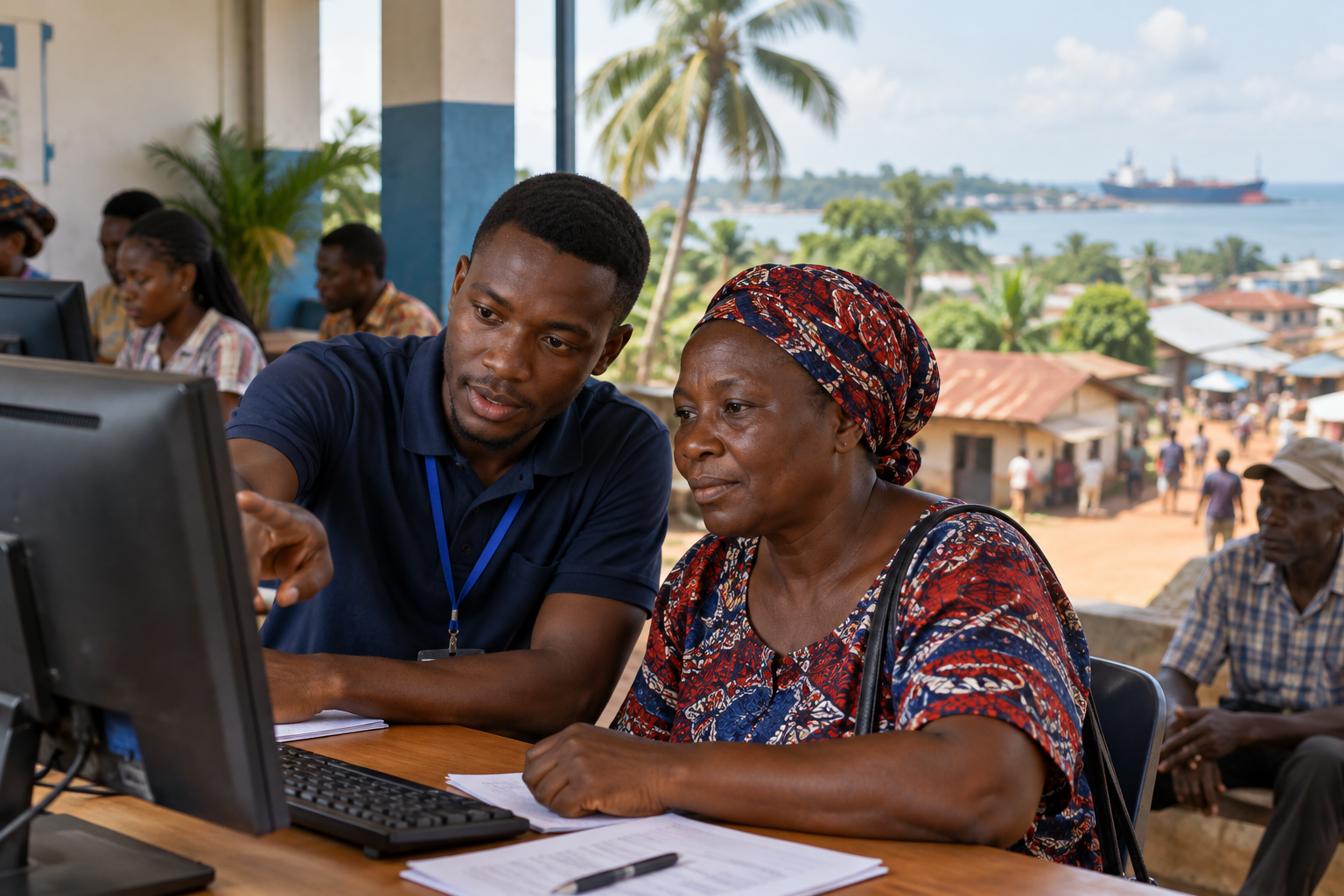
These would be dedicated service desks, perhaps located in government service centers, post offices, or trusted community hubs across all counties. Here, any citizen could receive guided help to complete an online transaction. This is not about staff taking a user’s personal information and completing the task for them; it is about providing shoulder-to-shoulder support. Consider these hypothetical scenarios:
- A hypothetical wholesaler needs to file a quarterly business tax return online but is unfamiliar with a proposed online portal. They could visit a designated service center, where a trained staff member helps them navigate the website on a public-use terminal, explaining each step and ensuring they understand the fee structure before payment.
- A high school graduate wants to apply for a government scholarship but does not own a computer. She could go to a designated assistance center and use their internet connection, with a facilitator on hand to help her scan and upload her academic documents correctly.
This approach requires that the digital services themselves be designed for accessibility. Interfaces must be clean, use plain, accessible language, and function smoothly on low-cost devices and over connections that may have limited bandwidth. All fees and requirements must be stated upfront, eliminating confusion and building trust. Crucially, a robust feedback mechanism, gathering input from users and assistance staff nationwide, would be essential for identifying and fixing real-world obstacles that system designers might not anticipate.
Tradeoffs and implementation risks
Of course, this model is not without costs and risks. Establishing and staffing assistance centers requires investment in training, salaries, and physical infrastructure, including reliable electricity and internet. The greatest risk, however, is to privacy and security. Staff must be rigorously trained in data protection and professional ethics to prevent the exploitation of vulnerable citizens. Clear protocols would be needed to ensure staff guide users without ever asking for passwords or directly handling sensitive financial information.
There is also the risk of creating a permanent dependency on in-person assistance. The goal of such centers should be twofold: to provide immediate access and to build long-term capacity. Each interaction can be a teaching moment. Over time, the aim should be to empower more citizens to complete these tasks independently, while recognizing that a segment of the population may always require or prefer direct assistance.
What global competence looks like here
Adopting an assisted access model would be a powerful statement of planning. It would demonstrate an understanding that modern governance is not about blindly importing technology, but about thoughtfully adapting it to the local context. A truly competent system is one that works for a market vendor as reliably as it does for a corporate lawyer.
Success should not be measured by the number of government websites launched. A more meaningful metric would be a comparison of service completion rates across different user groups and locations. For example, if an illustrative completion rate for a service were 95% in an urban center but only 15% in a rural county, that would not indicate a failure of the people in the rural county—it would indicate a failure of the system’s design. This data would provide a clear mandate to investigate the barriers and improve the service, ensuring that digital progress translates into nationwide progress.
Bottom line
A move toward greater digitalization offers significant opportunities, but also presents potential pitfalls. The greatest danger is creating a two-tiered system where the benefits of technology flow only to the privileged and digitally literate. By embracing the principle of assisted access, Liberia can avoid this trap. The lesson from regional project design is clear: inclusion cannot be an add-on. It must be integral to the strategy from the outset. Building systems that empower every citizen to participate in the digital economy is the only way to ensure that a national transformation is comprehensive, just, and sustainable.
Sources
- Burkina Faso: Scaled-up Support for Digital Transformation — World Bank, published 2024-01-23
Related reading

Design Digital Services Around a Completed Transaction
Inspired by the design of Rwanda's digital agenda, Liberia's public agencies should build online services that deliver a complete result, not just collect an application, to truly modernize and respect citizens' time.

Shared Data Standards Can Reduce Administrative Friction
Kenya’s plan for a data-driven public sector shows how shared technical standards could reduce the administrative friction that slows Liberia’s economy, starting with a pilot project between key agencies.

Artificial Intelligence Needs a Defined Job
To harness artificial intelligence effectively, Liberia must first define its specific job, starting with small, accountable tasks that build capability rather than chasing transformative but ill-defined ambitions.