
Liberia Can Build a Learning Network Around Practical Reform
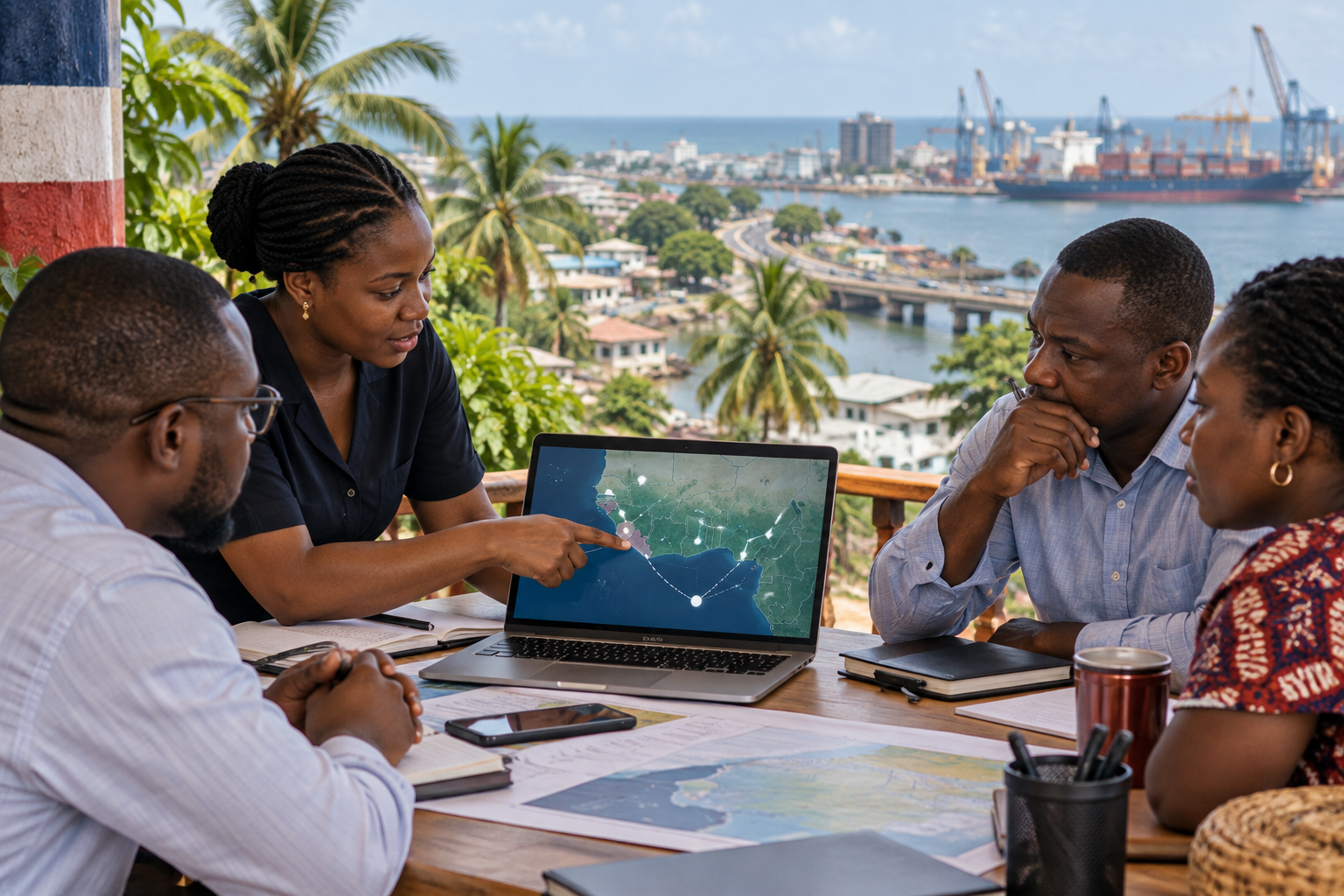
By studying the documented digital transformation plans of African peers, Liberia can create a practical, evidence-based learning network to test and adopt reforms that truly work for its own economy and institutions.

Editorial analysis. This piece reflects Executive Tea Chronicle's interpretation and editorial mission, not an official government position.
Analysis. Drafted from cited World Bank sources for editor review; Liberia proposals are the magazine's analysis, not source findings.
Source scope: the cited sources describe historical project designs and financing announcements (2021–2024), not verified current implementation outcomes. No new Liberia-specific factual evidence was checked for this draft; Liberia scenarios are hypothetical.
In economic development, a common challenge is the gap between strategic planning and tangible results. National strategies may not always translate into local impact, and models successful in one country can face obstacles in another. This suggests a need for an approach that moves beyond seeking a single, comprehensive blueprint from abroad. A more productive path could involve a disciplined, internal process of learning and adaptation.
Several African nations are pursuing significant digital and economic reforms, with project designs documented in publicly available financing agreements. The approaches taken in countries like Rwanda, Ghana, Kenya, and Burkina Faso can offer a catalog of options for addressing common challenges. A key consideration is to view these projects not as guaranteed successes to be copied, but as well-defined hypotheses to be studied. Through a professional learning network focused on practical reform, a country can analyze such models and discover what works for its own unique circumstances.
What the comparison shows
A review of selected World Bank-supported projects reveals a shared focus on digital transformation, but with distinct strategies tailored to national priorities. These plans provide a valuable menu of options, not a single recipe.
On infrastructure and access, for example, the approaches vary. A 2023 project for Kenya included a goal to expand the country’s fiber-optic backbone and mobilize private capital to connect rural and underserved areas where, according to the World Bank, over 70% of the population resides. A 2022 project in Ghana was designed to use financing to encourage private sector investment to extend broadband services to six million people in rural communities. By contrast, a 2021 project design for Rwanda included direct support for households, aiming to help 250,000 of them acquire smart devices.
The approaches to skills and entrepreneurship also differ. A 2023 World Bank project document for Burkina Faso was titled the “Entrepreneurship, Skills, and Technology Project,” indicating a focus on business and workforce development. Rwanda’s 2021 project design took a different angle, with objectives to provide basic digital literacy training to three million people and support 300 digital startups, with a stated focus on those owned by women.
Finally, in delivering public services, the scale of ambition is notable. Kenya's ICT Master Plan, referenced in its 2023 project financing, articulated a goal of digitizing 80% of government services. Rwanda's 2021 project included plans to develop at least 30 new or upgraded digital services and issue digital ID credentials to 75% of its population. A project approved for Burkina Faso in January 2024, as described in a World Bank release, aims to accelerate digital transformation in key social sectors like health and education, with a specific focus on reaching vulnerable groups such as internally displaced persons.
Analysis: applying the lesson in Liberia
The lesson from this comparison is not to choose one country's model, but rather to consider a method of defining a problem and designing a specific, measurable intervention. This process could be institutionalized through a professional learning network organized into working groups, each tasked with tackling a discrete challenge.
Consider these hypothetical examples for Liberia:
- Enterprise Records: A working group on MSME development, perhaps comprising representatives from an agency like the Liberia Business Registry, a commercial bank, and a body like the Liberia Chamber of Commerce, could be tasked with improving access to credit. Drawing inspiration from the focus on entrepreneurship in a project for Burkina Faso, it might design a pilot program. A hypothetical business owner could be given access to a simple accounting tool. After an illustrative period of six months, the group could analyze whether the resulting business records improve the owner's ability to secure a loan. The group would then be positioned to publish its findings on the tools used, the training method, the results, and the challenges.
- Accessible Services: A working group on public sector efficiency could bring together staff from a body like the Civil Service Agency and a local technology firm. Inspired by Rwanda's 2021 plan for new digital services, it could focus on one process, such as applying for a government permit. The group could develop and test a streamlined online application, launching it in a limited geographical area first. It could track metrics like application time, error rates, and user feedback before recommending a wider rollout.
- Workforce Preparation: A skills-focused working group with members from a government entity like the Ministry of Youth and Sports, a vocational training center, and a major private employer could address youth unemployment. Learning from the skills-related goals in both the Rwandan and Ghanaian projects, it could design a targeted, three-month course in digital marketing. The group could then track how many graduates secure employment within six months and, crucially, survey employers on the practical value of the skills taught.
Tradeoffs and implementation risks
This networked, experimental approach is not a panacea. It is methodical and incremental, which can feel slow compared to sweeping national declarations. Its success depends on the sustained commitment of professionals. A significant risk in such an approach is that of "pilot-itis"—a series of small projects that are never scaled or integrated into institutional practice. The credibility of such an effort would hinge on transparency. Working groups would need to be empowered and expected to report honestly, especially about failure. A pilot that proves an idea is too costly, too complex, or simply ineffective for a given context is a valuable finding that saves resources and directs future efforts more productively.
What global competence looks like here
Global competence is not just about knowing what others are doing; it is about having the capacity to act upon that knowledge within a specific environment. A learning network embodies this principle. It can build a permanent asset: a community of practice where professionals develop a shared language for problem-solving, a repository of evidence about what works locally, and the trusted relationships needed to foster collaboration across different organizations. By documenting and publishing its methods and findings, such a network would not just be borrowing ideas. It would be generating new knowledge—data on adapting digital tools for specific local contexts—that could be valuable to peers facing similar challenges. This is how a country can contribute to the global conversation on development, shifting from analysis to innovation.
Bottom line
The path to a more resilient and dynamic economy is unlikely to be found in a single imported master plan. It can be built through a disciplined process of inquiry, experimentation, and collaboration. The documented project designs from Rwanda, Ghana, Kenya, and Burkina Faso offer a powerful set of starting points for this work. They are not answers, but well-formed questions. By creating a structure to test these questions systematically, Liberia can build more than just new systems or infrastructure; it can build the most critical asset of all: the institutional capacity to learn and adapt for itself.
Sources
- World Bank Provides $100 Million to Accelerate Rwanda’s Digital Transformation — World Bank, published 2021-12-01; event 2021-11-30
- World Bank Provides $200 Million to Accelerate Ghana’s Digital Transformation Agenda for Better Jobs — World Bank, published 2022-04-28
- Burkina Faso - Entrepreneurship, Skills, and Technology Project (Project Appraisal Document, P177005) — World Bank, published 2023-04-17
- Kenya and the World Bank Group Provide a $390 Million Boost the Digital Economy — World Bank, published 2023-04-05
- Burkina Faso: Scaled-up Support for Digital Transformation — World Bank, published 2024-01-23
Related reading

Learn From Institutions Through Defined Assignments
To truly benefit from the experiences of peer nations like Rwanda, Liberian institutions must shift from general study tours to assignment-based exchanges focused on solving specific problems back home.
Regional Partnerships Need Compatible Technical Practices
To make regional partnerships work, Liberia can learn from Kenya's digital strategy by focusing on the practical, technical groundwork needed for dependable cross-border collaboration.

Partnership Agreements Should Include Knowledge Transfer
Inspired by Ghana's digital investment, Liberia must demand that development partnerships move beyond delivering systems to transferring the knowledge required for genuine, long-term ownership and sustainability.