
Partnerships Should Share What Did Not Work
To truly benefit from international partnerships, Liberia must build frameworks that study unsuccessful interventions as rigorously as successful ones, turning implementation setbacks into actionable economic intelligence.
Editorial analysis. This piece reflects Executive Tea Chronicle's interpretation and editorial mission, not an official government position.
Analysis. Drafted from cited World Bank sources for editor review; Liberia proposals are the magazine's analysis, not source findings.
Source scope: the cited sources describe historical project designs and financing announcements (2021–2024), not verified current implementation outcomes. No new Liberia-specific factual evidence was checked for this draft; Liberia scenarios are hypothetical.
International development partnerships are often announced with a script of optimism. A press release details ambitious goals, a signing ceremony provides a photo opportunity, and the public is presented with a vision of progress. This is the necessary language of ambition. Yet, arguably the most valuable part of a partnership is not only the list of what is intended to go right, but also the shared investigation of what goes wrong. A key test of collaboration is not just in celebrating anticipated outcomes, but in dissecting the complex reality of implementation.
A 2023 project design for Burkina Faso offers a template for consideration, not just for its content but for the questions it raises about institutional learning. The plan is comprehensive, targeting the interconnected systems that support small businesses. Its scope implies that not every initiative will succeed as planned. A mature partnership could plan for this from the start, agreeing that discovering the why behind a challenging intervention is as crucial as scaling up a successful one. This is not about assigning blame; it is about building institutional intelligence.
What the comparison shows
The structure of the Burkina Faso plan, approved for World Bank support, provides a useful mirror for national economic aspirations. According to a project appraisal document from April 17, 2023, the Entrepreneurship, Skills, and Technology Project is designed to increase micro, small, and medium-sized enterprises’ (MSMEs) access to finance, technology, and a better-trained workforce. This is not a single-threaded program but a multi-pronged approach that acknowledges the complex reality of enterprise growth.
The project's design, as described in the World Bank document, is built on three core pillars with a fourth for emergencies:
- A better enabling environment: This component aims to improve the overall business climate while also strengthening the specific capabilities of MSMEs and encouraging them to adopt new technologies.
- Improved access to finance: The plan intends to expand the reach of an existing partial credit guarantee portfolio to promote MSME financing.
- A more productive labor force: The design links the other goals to human capital, seeking to improve formal technical and vocational education (TVET) and to increase recognized training opportunities for low-skilled youth who may be outside the formal system.
The document also includes a contingent emergency response component, a pragmatic inclusion that allows for flexibility in a crisis. The key lesson here is the integrated design. The project’s authors appear to have reasoned that a business may struggle to get a loan without a good plan, adopt technology without skilled workers, or thrive in a challenging regulatory environment. The plan is a hypothesis about how these pieces fit together. For Liberia, the value would lie in treating such a plan not as a guaranteed solution, but as a live experiment worth monitoring closely.
Analysis: applying the lesson in Liberia
Liberia could seek partnerships that embrace this experimental mindset. Instead of simply importing a list of objectives from another country’s project document, a strategic approach could be to propose a new clause in development agreements: a joint commitment to document and analyze potential adoption problems, delivery challenges, and failed assumptions. This requires moving beyond reporting that focuses solely on whether targets were met.
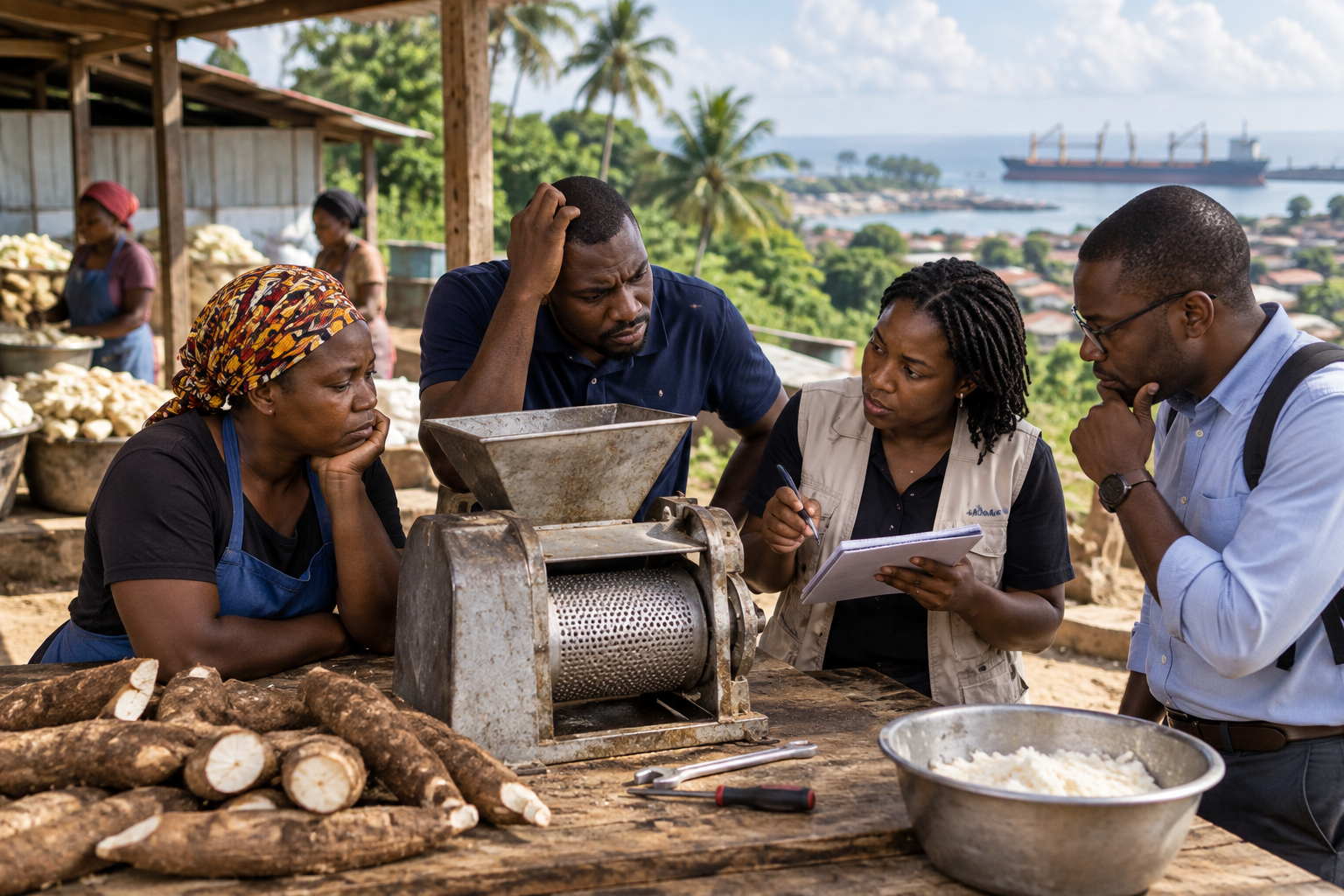
In a hypothetical example, a program to support cassava processors might include access to a new type of grating machine and a credit line to purchase it. If, after a year, an illustrative rate of only 20% of the targeted processors have taken up the offer, a standard report might simply note the shortfall. A partnership designed for learning, however, would fund an assessment to find out why. The reasons could be varied: were there technical issues, such as a lack of spare parts? Did the operational costs outweigh the efficiency gains? Was the loan application process too cumbersome for the intended entrepreneurs? The answers would be invaluable for designing the next, better intervention.
Consider another hypothetical: a wholesaler is given software and training to digitize inventory. If the business reverts to paper ledgers within six months, the initiative is not a write-off; it is a data point. A joint review between the implementing partner and a local business association could uncover the real friction. Perhaps the software’s design assumed a level of infrastructure, such as constant electricity, that was not available. Or perhaps it was not compatible with locally prevalent payment methods. Discovering such operational barriers helps protect future funding from being used on the same flawed assumption. Protecting commercial confidentiality is paramount; the goal is to anonymize specifics and share the systemic lesson.
Tradeoffs and implementation risks
This approach is not without challenges. It requires a significant level of trust and political will. Development partners and government agencies can be structured to report success, and funding is often tied to hitting predefined metrics. Acknowledging shortfalls can feel risky. A partnership agreement would have to explicitly create a protected space for this kind of analysis, framing it as a core project deliverable, not as an admission of failure.
Furthermore, there is a resource cost. Conducting rigorous analysis of struggling interventions requires time and expertise. This is an investment in institutional knowledge. The tradeoff is spending a small portion of a project's budget to understand implementation reality, thereby making all future spending in that sector more effective. It is a strategic shift from focusing solely on the 'what' (the immediate deliverable) to understanding the 'how' and 'why' (the context and conditions for success).
What global competence looks like here
Global competence, in a Liberian context, would not be the ability to perfectly replicate a project from Burkina Faso or elsewhere. It would be the capacity to establish partnerships that accelerate learning about the domestic economy. This would mean establishing processes for communicating to a funding partner when a well-intentioned plan is hitting unforeseen barriers, and then working collaboratively to determine why. This could transform a classic donor-recipient dynamic into a genuine analytical collaboration.
In joint review meetings, the conversation could shift from a simple progress checklist to a more sophisticated diagnostic dialogue. For instance: is the project facing a design problem (the initial assumption was wrong) or an implementation gap (the idea is sound but the delivery mechanism is not performing as expected)? Making this distinction is critical. One requires a change in strategy, the other a change in operations. Building this capacity for honest, evidence-based course correction is arguably a more sustainable development outcome than any single infrastructure project.
Bottom line
The ambition embedded in comprehensive projects like the one designed for Burkina Faso is necessary. For Liberia, a next step could be to partner not just for implementation, but for shared discovery. A strategic approach would be to seek collaborations that formally value the lessons from what does not work as much as they celebrate what does. A partnership that helps explain why a new technique might be rejected by a group of farmers is ultimately more valuable than one that simply reports the number of workshops held. When both sides can identify what to change without fear of reprisal, the relationship moves beyond funding to become a true engine of insight, ensuring that future investments are guided by demonstrated needs and the realities of the local operating environment.
Sources
- Burkina Faso - Entrepreneurship, Skills, and Technology Project (Project Appraisal Document, P177005) — World Bank, published 2023-04-17
Related reading

Learn From Institutions Through Defined Assignments
To truly benefit from the experiences of peer nations like Rwanda, Liberian institutions must shift from general study tours to assignment-based exchanges focused on solving specific problems back home.
Regional Partnerships Need Compatible Technical Practices
To make regional partnerships work, Liberia can learn from Kenya's digital strategy by focusing on the practical, technical groundwork needed for dependable cross-border collaboration.

Partnership Agreements Should Include Knowledge Transfer
Inspired by Ghana's digital investment, Liberia must demand that development partnerships move beyond delivering systems to transferring the knowledge required for genuine, long-term ownership and sustainability.