
Fragility Lessons Should Be Adapted With Care
Burkina Faso's new plan to use digital tools for displaced populations offers a vital, but not complete, lesson for Liberia on how to design public services that are inclusive, resilient, and built for challenging realities.
Editorial analysis. This piece reflects Executive Tea Chronicle's interpretation and editorial mission, not an official government position.
Analysis. Drafted from cited World Bank sources for editor review; Liberia proposals are the magazine's analysis, not source findings.
Source scope: the cited sources describe historical project designs and financing announcements (2021–2024), not verified current implementation outcomes. No new Liberia-specific factual evidence was checked for this draft; Liberia scenarios are hypothetical.
In the search for development models, it is tempting to look for success stories that can be imported wholesale. Yet, valuable lessons can often come not from polished outcomes, but from thoughtful designs forged in difficult circumstances. Analytical competence lies in the careful work of understanding why a particular approach was chosen elsewhere, and then adapting the underlying principle—not the entire program—to a specific national context. This requires discipline, humility, and a clear-eyed view of both the opportunity and its limits.
A 2024 project design for Burkina Faso provides a compelling case study. It is an initiative that explicitly puts the needs of the most vulnerable, including internally displaced persons (IDPs), at the center of a national digital strategy. For countries where maintaining public services amid fragility is a critical concern, this is an approach that warrants attention. The challenge is not to copy Burkina Faso, but to learn from its planning for disruption from the very start.
What the comparison shows
Understanding the transferable lesson requires looking at the specifics of the plan. According to a World Bank press release from January 2024, the institution approved a $150 million Digital Acceleration Project for Burkina Faso. The project, financed by its International Development Association (IDA) fund, seeks to improve access to digital infrastructure, public services, and skills development. It is designed as a follow-on operation, intended to build upon the achievements of previous digital initiatives in the country.
What makes this project noteworthy for observers is its explicit design focus. The World Bank stated that the project will target several vulnerable populations, specifically naming IDPs and rural communities. The press release frames this as a recognition of digital technology’s potential to address fragility and strengthen resilience. The stated objectives include expanding broadband connectivity into areas hosting displaced persons, accelerating the digital transformation of public services like education and health, and training public administration staff. This is not a story of proven results, but a blueprint for proactive inclusion—a decision to build a system with the most challenging users in mind from day one.
Analysis: applying the lesson in Liberia
The core principle that could be adapted for a Liberian context is this: designing for the margins can make the center stronger. A system built to serve a citizen who is displaced, has variable connectivity, and needs secure access to records can be more robust for everyone. Instead of importing a specific technology, this resilience principle could be applied to public service reform proposals in Liberia.
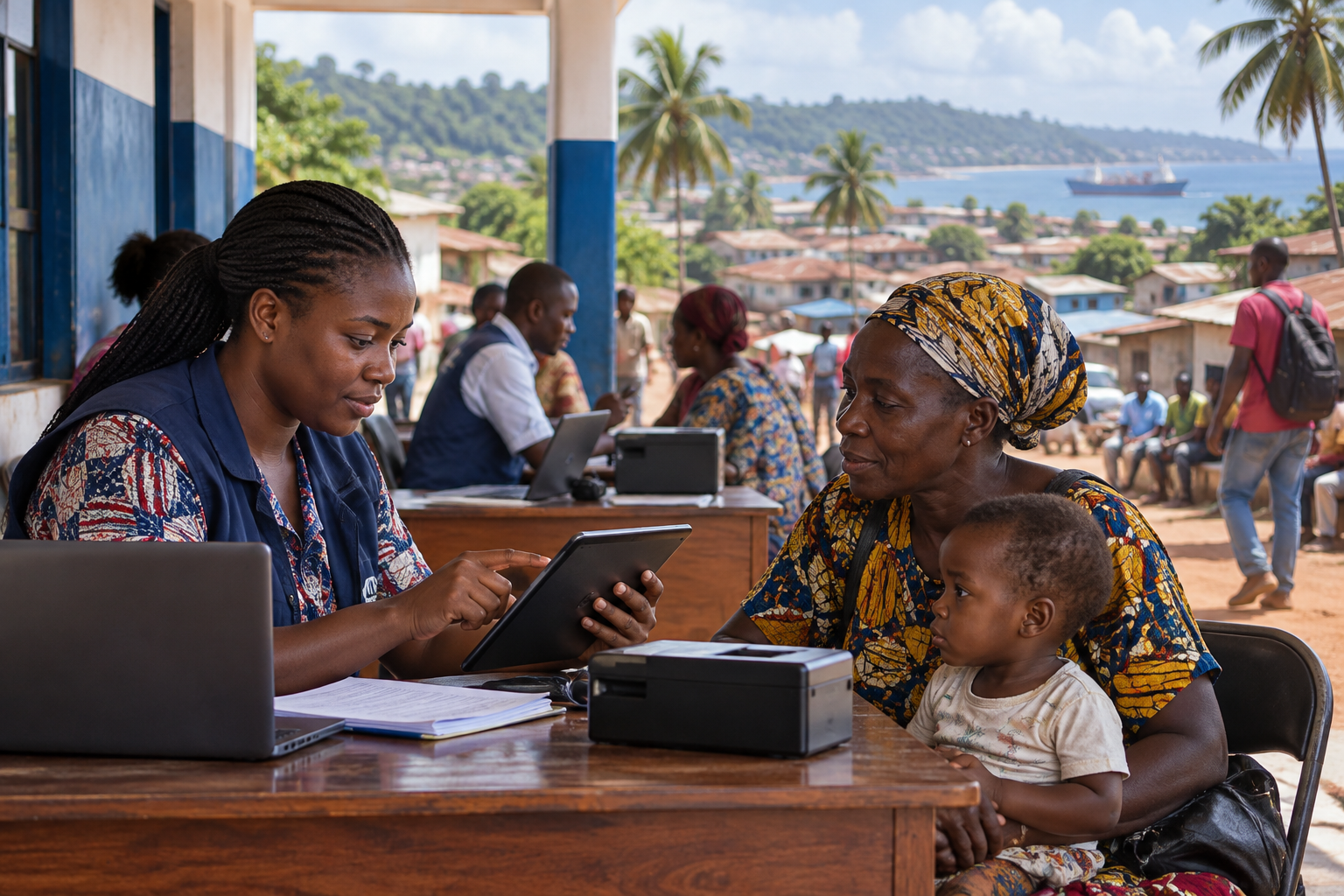
- Accessible service channels: A hypothetical project to digitize birth certificates or business permits could be designed from the start with multiple channels in mind. This might mean an online portal, but also a simple, low-bandwidth system for use in areas with poor connectivity, and an offline-capable application for civil servants in county service centers. The system would aim to ensure a consistent record, regardless of how it was accessed.
- Continuity of records: In a hypothetical example, a wholesaler's physical business license is destroyed in a fire. A resilience-focused system would mean their record is not stored only in one physical location. They could then go to an agent in a different town, verify their identity, and get a new copy printed, ensuring business continuity. This is about planning for failure points.
- Staff preparedness: Technology is only part of the solution. An adaptation in Liberia could focus on training civil servants not just on how to use a new system, but on how to implement contingency protocols. A hypothetical program at the Liberia Institute of Public Administration might include simulations where staff must re-establish essential services after a simulated disruption, using a toolkit of pre-approved simplified methods.
Tradeoffs and implementation risks
Adapting this principle requires acknowledging significant risks and tradeoffs. The context in Burkina Faso, with its specific displacement crises, is not identical to every other country's. A direct copy would be ill-advised. A common risk in digital projects is over-engineering a system that is too complex or expensive for immediate needs and available budgets. A goal could be a minimum viable product that solves a core problem, not a perfect system that is never launched.
Furthermore, any push for digital services risks deepening the digital divide. In any context where digital access and literacy are not universal, a project that relies solely on smartphones and high-speed internet risks excluding portions of the population. Therefore, any such initiative in Liberia would need to consider a robust non-digital component, such as paper-based transaction receipts that can be verified later, or a network of human intermediaries. Finally, creating centralized digital records poses security and privacy risks. Investment in cybersecurity, data protection laws, and transparent governance must be a foundational part of any such project, not an afterthought.
What global competence looks like here
This careful analysis is what adapting global lessons can look like in practice. It is not about finding a foreign “answer.” It is the process of identifying a relevant strategic principle from another country's experience and using it as a lens to examine local challenges. It means having the confidence to break down a large project from abroad into smaller, testable ideas that can be adapted to Liberian realities.
Practically, this could involve starting with a limited pilot—perhaps in one sector like agriculture or education in one or two counties. Crucially, it would require extensive consultation with the intended users before a single line of code is written. By talking to hypothetical farmers in Nimba or small-scale traders in Grand Bassa, developers and policymakers can better understand actual needs, constraints, and levels of trust, ensuring a solution is useful, not just technically impressive.
Bottom line
The World Bank's project approval for Burkina Faso is not a solution for Liberia, but it is an invaluable prompt. It encourages asking a fundamental question: are public service modernization efforts in Liberia being designed with resilience and inclusion at their core? The most durable progress can come from embracing the principle of planning for disruption, but realizing it through small, practical, and locally-grounded steps. The aim should be a tangible service improvement supported by evidence, rather than the grand announcement of a borrowed strategy. That is how to build a system that can serve all citizens, in good times and in bad.
Sources
- Burkina Faso: Scaled-up Support for Digital Transformation — World Bank, published 2024-01-23
Related reading

Learn From Institutions Through Defined Assignments
To truly benefit from the experiences of peer nations like Rwanda, Liberian institutions must shift from general study tours to assignment-based exchanges focused on solving specific problems back home.
Regional Partnerships Need Compatible Technical Practices
To make regional partnerships work, Liberia can learn from Kenya's digital strategy by focusing on the practical, technical groundwork needed for dependable cross-border collaboration.

Partnership Agreements Should Include Knowledge Transfer
Inspired by Ghana's digital investment, Liberia must demand that development partnerships move beyond delivering systems to transferring the knowledge required for genuine, long-term ownership and sustainability.