
Inclusive Administration Must Plan for Disruption
Inspired by a World Bank project design for Burkina Faso, Liberian public administration can build resilience by proactively planning for service continuity during disruptions, ensuring no citizen is left behind in a crisis.
Editorial analysis. This piece reflects Executive Tea Chronicle's interpretation and editorial mission, not an official government position.
Analysis. Drafted from cited World Bank sources for editor review; Liberia proposals are the magazine's analysis, not source findings.
Source scope: the cited sources describe historical project designs and financing announcements (2021–2024), not verified current implementation outcomes. No new Liberia-specific factual evidence was checked for this draft; Liberia scenarios are hypothetical.
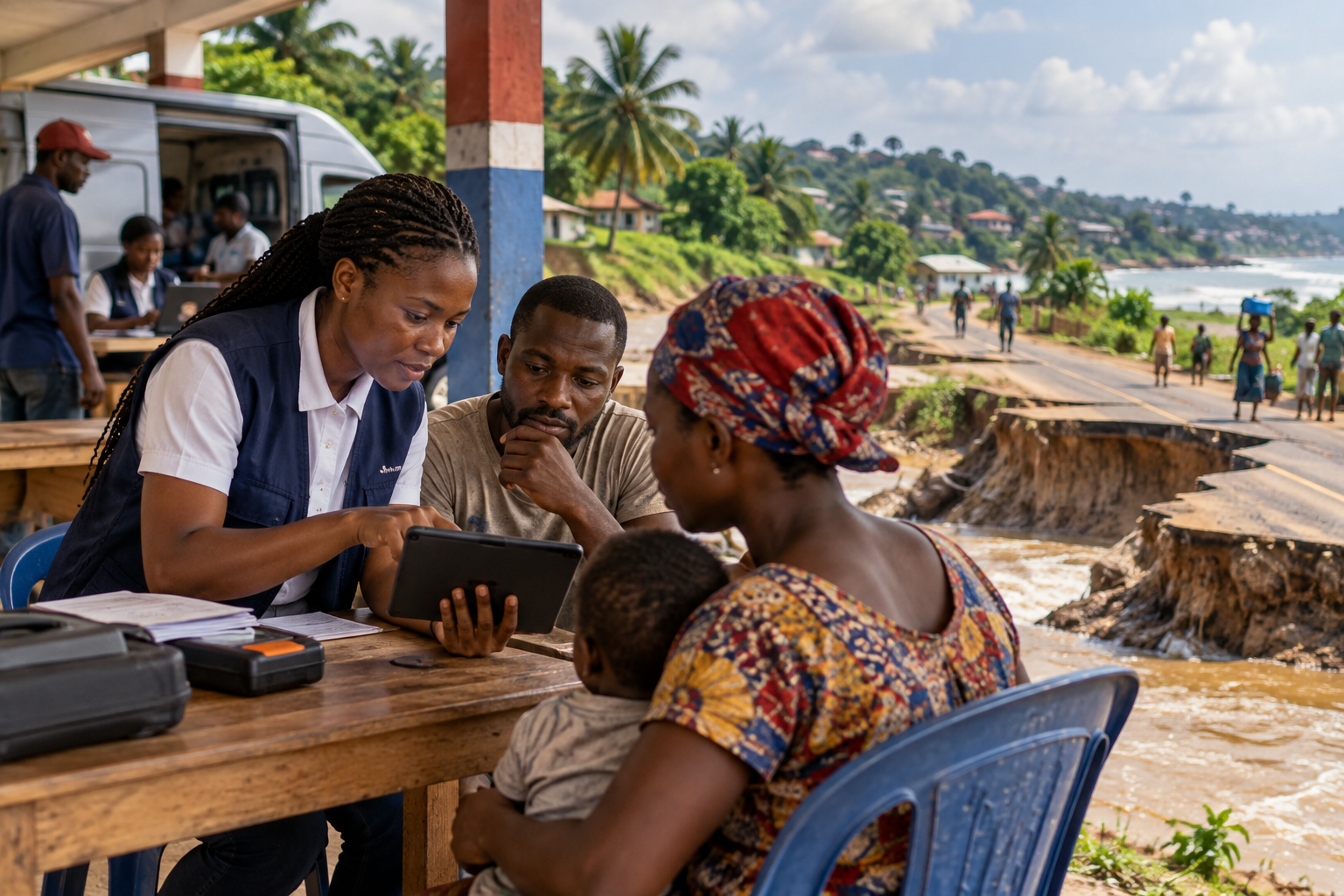
Effective governance is often measured by its smooth, day-to-day operations. But the true test of an inclusive and resilient state lies in its response to disruption. When a flood washes out a road, a fire destroys a market, or communal tensions force families to flee their homes, can citizens still access the essential services they depend on for their security and livelihood? This is not merely a question of emergency response, but one of administrative design. An institution built for resilience anticipates failure points and plans for them.
A compelling example of this approach can be found in the design of a West African development project announced in 2024. According to a World Bank press release of 23 January 2024, the institution approved the $150 million Digital Acceleration Project for Burkina Faso. The project’s stated purpose is not only to expand digital infrastructure and services but to explicitly target vulnerable populations, including internally displaced persons (IDPs) and rural communities. This proactive inclusion of those already facing profound disruption offers a powerful lesson in administrative planning.
Liberia's circumstances are not identical to Burkina Faso's, but the principle is universal. A key question for Liberia is whether public institutions are designed with the displaced, the isolated, and the unfortunate in mind. Or do administrative systems generally tend to assume a level of stability that can vanish in an instant? Learning from this design means embedding contingency into the DNA of public administration.
What the comparison shows
The Burkina Faso project, financed by the World Bank's International Development Association (IDA), demonstrates a comprehensive vision for resilience. The official announcement outlines a multi-layered strategy that aims to improve broadband access, accelerate the digital transformation of public services like education and health, and develop digital skills for both public servants and young people. The project is designed to build upon the work of previous initiatives, indicating a sustained, strategic effort.
The critical element for this magazine’s analysis is the project’s specific focus. The World Bank announcement notes the project's aim to increase broadband connectivity in areas vulnerable to climate shocks and those hosting displaced persons. A Bank official is cited as highlighting the potential of digital technology to address fragility and strengthen resilience. By embedding support for IDPs directly into the project's framework, the design acknowledges that a significant portion of the population may not be able to access services through traditional, stable channels. It plans for this reality from the outset.
This is not a report of delivered results, but a look at the blueprint for action. The project’s architects have identified a predictable challenge—the exclusion of displaced populations—and have integrated a solution into the core design. The lesson is not to copy the technology or the specific program, but to adopt the mindset: inclusive administration must plan for disruption.
Analysis: applying the lesson in Liberia
For Liberia, embracing this lesson would mean shifting from a reactive posture to a proactive one. It would require public institutions to develop their own internal “Continuity of Service” plans, tailored to the Liberian context. This goes beyond generic disaster management and delves into the specific administrative procedures that define the relationship between the state and the citizen.
Consider a few hypothetical scenarios:
- If seasonal flooding in a rural county were to make a local revenue office inaccessible for weeks, how could a small business owner remit taxes without penalty? A continuity plan could pre-establish alternative payment methods, perhaps through a mobile money integration or a temporary service desk set up at a partner bank in a nearby town.
- A hypothetical wholesaler in Gbarnga loses all their paper records in a warehouse fire. When they apply for a loan, they need to prove their history of tax compliance. In this scenario, if the Liberia Revenue Authority had previously implemented a secure digital record-keeping system, it could verify the business’s status internally, preventing the disaster from causing a secondary economic failure for the entrepreneur.
- Following a localized land dispute that forces several families to relocate temporarily, they find themselves unable to register their children in a new school because they fled without documents. A Ministry of Education with a continuity plan might have procedures for principals to provisionally enroll students based on an affidavit, with staff trained to help families recover records through a centralized, backed-up database.
Developing such plans involves identifying a ministry’s most essential public-facing services, mapping the potential points of failure, and creating clear, actionable protocols for staff to follow when normal operations are impossible. This includes securing and backing up critical records, designating alternative service locations, and leveraging technology to support, not replace, human assistance.
Tradeoffs and implementation risks
This approach is not without challenges. Digitizing records and building secure backup systems can require significant upfront investment, a difficult tradeoff for any government with competing budgetary priorities. Furthermore, digital systems create new vulnerabilities, primarily to data breaches and cyberattacks, making robust security measures a prerequisite, not an afterthought. There is also the risk of deepening the digital divide. A plan that relies too heavily on online portals will be of little use to people with limited internet access or digital literacy, a common challenge to consider. Any technological solution must be paired with human-powered, on-the-ground alternatives, like mobile service teams or temporary physical offices.
Perhaps the most significant risk is one of implementation. A brilliant plan that remains on a shelf is useless. Staff must be trained not just on the procedures, but on the underlying principle of fairness. They would need clear guidance on how to handle situations with empathy and flexibility—for example, how to assess a citizen’s claim of lost documents without opening the door to fraud, but also without unjustly penalizing the victim of a real crisis.
What global competence looks like here
In the modern world, institutional competence is no longer just about efficiency under ideal conditions. It is about agility and robustness under stress. Adopting a continuity-of-service mindset is a hallmark of a globally competent public sector. It demonstrates an understanding that the state’s fundamental responsibility is to provide a reliable platform for people's lives and commerce, especially when their own foundations are shaken.
To build this competence, institutions could conduct readiness exercises. A ministry could simulate a scenario—a key office becoming inaccessible, a major data connection failing—to pressure-test its continuity plan. These drills would reveal gaps in training, technology, and procedure before a real crisis hits, allowing for refinement. This is how organizations can build institutional muscle memory for resilience.
Bottom line
The core insight from the Burkina Faso project’s design is not about technology; it is about foresight. By planning to serve the displaced, its architects affirmed that a government’s reach must extend to all its people, wherever they are and whatever their circumstances. For Liberia, the path forward involves embedding this same foresight into the country's administrative culture. The question for any government is not whether its systems work under ideal conditions. The relevant question is whether a citizen who has lost everything in a crisis can still count on the state for the essential support they need to rebuild. Answering that question with a confident “yes” is the foundation of a truly inclusive and resilient republic.
Sources
- Burkina Faso: Scaled-up Support for Digital Transformation — World Bank, published 2024-01-23
Related reading

Public Performance Should Be Measured Through Service Results
Liberia should measure public performance not by launching digital platforms, but by tracking and publishing the concrete service results they deliver to citizens and businesses, using data to drive accountability and improvement.

Procurement Transparency Begins Before a Contract Is Awarded
To ensure public funds deliver real value, procurement transparency must begin with clear, published needs and evaluation criteria, a disciplined lesson for Liberia's development agenda.

Civil Servants Need Practical Digital Confidence
Liberia can modernize its public sector by adapting Burkina Faso's focus on practical, job-specific digital training that builds civil servant confidence, improves professional judgment, and leads to measurably better service delivery.